Senate passes Democrats’ sweeping health care and climate bill
Aug 7, 2022, 2:00 PM | Updated: Aug 10, 2022, 10:50 am
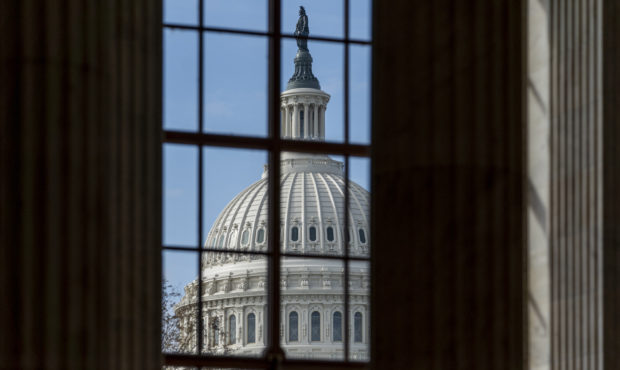
The Capitol is framed through a window in the Russell Senate Office Building in Washington, Wednesday, March 18, 2020. (AP Photo/J. Scott Applewhite)
(AP Photo/J. Scott Applewhite)
(CNN) — The Senate voted Sunday afternoon to pass Democrats’ sweeping health care and climate bill, sending it to the House of Representatives, in a significant victory for President Joe Biden and his party.
The bill — named the Inflation Reduction Act — would represent the largest climate investment in US history and make major changes to health policy by giving Medicare the power for the first time to negotiate the prices of certain prescription drugs and extending expiring health care subsidies for three years. The legislation would reduce the deficit, be paid for through new taxes — including a 15% minimum tax on large corporations and a 1% tax on stock buybacks — and boost the Internal Revenue Service’s ability to collect.
It would raise over $700 billion in government revenue over 10 years and spend over $430 billion to reduce carbon emissions and extend subsidies for health insurance under the Affordable Care Act and use the rest of the new revenue to reduce the deficit.
The package is the product of painstaking negotiations, and its passage would give Democrats a chance to achieve major policy objectives ahead of the upcoming midterm elections.
The Democrat-controlled House, which is expected to take up the legislation on Friday, August 12, must approve the bill before Biden can sign it into law.
Senate Democrats, with a narrow 50-seat majority, stayed unified to pass the legislation, using a special process to approve the measure without Republican votes. Final passage came after a marathon series of contentious amendment votes known as a “vote-a-rama” that stretched from late Saturday night until Sunday afternoon.
How Senate Democrats passed the bill on a party-line vote
Senate Democrats have long hoped to pass a signature legislative package that would incorporate major agenda items for the party, but struggled for months to reach a deal that gained full support of their caucus.
Sen. Joe Manchin played a key role in shaping the legislation — which only moved forward after the West Virginia Democrat and Senate Majority Leader Chuck Schumer announced a deal at the end of July, a major breakthrough for Democrats after earlier negotiations had stalled out.
Arizona Sen. Kyrsten Sinema on Thursday night offered critical support after party leaders agreed to change new tax proposals, indicating she would “move forward” on the sweeping economic package.
But Sinema, Manchin and other senators worked through the weekend making crucial alterations on the bill.
To avoid a last-minute collapse of the bill on Sunday, Democrats created a plan to win over Sinema, who was concerned over the 15% corporate minimum tax’s impact on subsidiaries owned by private equity. Senate Democrats accepted a narrower tax proposal, but instead of paying for it through a change to the state and local tax deduction, which would’ve drawn opposition from some House Democrats, they instead extended the limitation on the amount of losses that businesses can deduct for another two years.
Republicans used the weekend “vote-a-rama” to put Democrats on the spot and force politically tough votes. They were also successful in removing a key insulin provision to cap the price of insulin to $35 per month on the private insurance market, which the Senate parliamentarian ruled was not compliant with the Senate’s reconciliation rules. The $35 insulin cap for Medicare beneficiaries remains in place.
How the bill addresses the climate crisis
While economists disagree over whether the package would, in fact, live up to its name and reduce inflation, particularly in the short term, the bill would have a crucial impact on reducing carbon emissions.
The nearly $370 billion clean energy and climate package is the largest climate investment in US history, and the biggest victory for the environmental movement since the landmark Clean Air Act. It also comes at a critical time; this summer has seen punishing heat waves and deadly floods across the country, which scientists say are both linked to a warming planet.
Analysis from Senate Majority Leader Chuck Schumer’s office — as well as multiple independent analyses — suggests the measure would reduce US carbon emissions by up to 40% by 2030. Strong climate regulations from the Biden administration and action from states would be needed to get to President Joe Biden’s goal of cutting emissions 50% by 2030.
The bill also contains many tax incentives meant to bring down the cost of electricity with more renewables, and spur more American consumers to switch to electricity to power their homes and vehicles.
Lawmakers said the bill represents a monumental victory and is also just the start of what’s needed to combat the climate crisis.
“This isn’t about the laws of politics, this is about the laws of physics,” Democratic Sen. Brian Schatz of Hawaii told CNN. “We all knew coming into this effort that we had to do what the science tells us what we need to do.”
Key health care and tax policy in the bill
The bill would empower Medicare to negotiate prices of certain costly medications administered in doctors’ offices or purchased at the pharmacy. The Health and Human Services secretary would negotiate the prices of 10 drugs in 2026, and another 15 drugs in 2027 and again in 2028. The number would rise to 20 drugs a year for 2029 and beyond.
This controversial provision is far more limited than the one House Democratic leaders have backed in the past. But it would open the door to fulfilling a longstanding party goal of allowing Medicare to use its heft to lower drug costs.
Democrats are also planning to extend the enhanced federal premium subsidies for Obamacare coverage through 2025, a year later than lawmakers recently discussed. That way, they wouldn’t expire just after the 2024 presidential election.
To boost revenue, the bill would impose a 15% minimum tax on the income large corporations report to shareholders, known as book income, as opposed to the Internal Revenue Service. The measure, which would raise $258 billion over a decade, would apply to companies with profits over $1 billion.
Concerned about how this provision would affect certain businesses, particularly manufacturers, Sinema has suggested that she won changes to the Democrats’ plan to pare back how companies can deduct depreciated assets from their taxes. The details remain unclear.
However, Sinema nixed her party’s effort to tighten the carried interest loophole, which allows investment managers to treat much of their compensation as capital gains and pay a 20% long-term capital gains tax rate instead of income tax rates of up to 37%.
The provision would have lengthened the amount of time investment managers’ profit interest must be held from three years to five years to take advantage of the lower tax rate. Addressing this loophole, which would have raised $14 billion over a decade, had been a longtime goal of congressional Democrats.
In its place, a 1% excise tax on companies’ stock buybacks was added, raising another $74 billion, according to a Democratic aide.
Related Stories:
- Bipartisan group of senators announce agreement on gun control
- President Joe Biden officially cleared to emerge from isolation following rebound Covid-19 case
- Why are Utah Democrats backing Evan McMullin?