Research in pigs shakes up what we know about dying
Aug 4, 2022, 5:00 AM | Updated: Aug 21, 2022, 6:03 pm
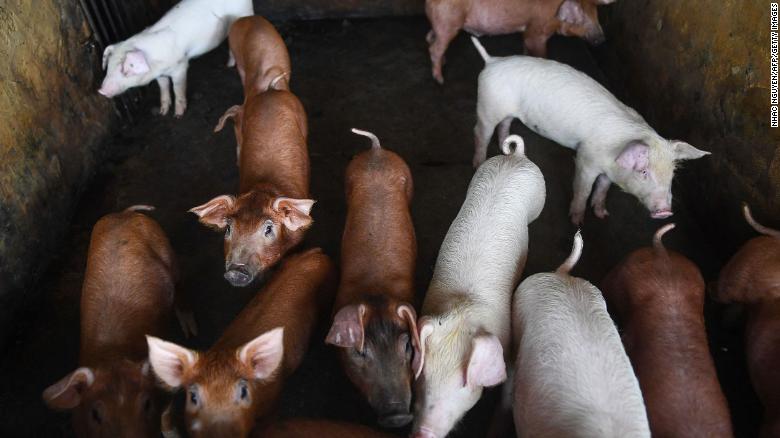
Pigs are seen in a pen in a farm on the outskirts of Hanoi on June 2. (CNN)
(CNN)
(CNN) — Researchers at Yale University say they have been able to restore blood circulation and other cellular functions in pigs a full hour after the animals’ deaths, suggesting that cells don’t die as quickly as scientists had assumed.
With more research, the cutting-edge technique could someday potentially help preserve human organs for longer, allowing more people to receive transplants.
The researchers used a system they developed called OrganEx which enables oxygen to be recirculated throughout a dead pig’s body, preserving cells and some organs after a cardiac arrest.
“These cells are functioning hours after they should not be,” said Dr. Nenad Sestan, the Harvey and Kate Cushing Professor of Neuroscience and professor of comparative medicine, genetics and psychiatry at Yale, who led the study.
“And what this tells us is that the demise of cells can be halted. And their functionality restored in multiple vital organs. Even one hour after death,” he told a news briefing.
The scientific journal Nature published the research on Wednesday.
“This is a truly remarkable and incredibly significant study. It demonstrates that after death, cells in mammalian organs (including humans) such as the brain do not die for many hours. This is well into the post-mortem period,” Dr. Sam Parnia, an associate professor of critical care medicine and director of critical care and resuscitation research at NYU Grossman School of Medicine, told the Science Media Centre in London. Parnia wasn’t involved in the research.
The OrganEx system pumps a fluid called a perfusate, mixed with blood, throughout the dead pigs’ blood vessels. The perfusate contains a synthetic form of the protein hemoglobin and several other compounds and molecules that help protect cells and prevent blood clots. Six hours after treatment with OrganEx, the team found that certain key cellular functions were active in many areas of the pigs’ bodies — including in the heart, liver and kidney, and that some organ function had been restored.
It builds on research published by the same team in 2019 that used a similar experimental system called BrainEx that delivered artificial blood to pigs’ brains, preventing degradation of important neural functions.
How could the research be applied to humans?
While the research is still at an extremely early stage and very experimental, the researchers said they hoped that their work in pigs could ultimately be applied to humans, primarily in terms of developing ways to extend the window for transplants. The current supply of organs is extremely limited, with millions of people worldwide waiting for transplants.
“I think the technology has a great deal of promise for our ability to preserve organs after they’re removed from a donor,” said coauthor Stephen Latham, director of the Yale Interdisciplinary Center for Bioethics, at the briefing.
“You could take the organ from a deceased donor, and hook it up to the perfusion technology, and perhaps then be able to transport it long distance over a long period of time to get it to a recipient who needs it.”
The researchers made clear that they were not in any sense bringing the pigs back to life and more work would need to be done to understand whether the organs were useable for transplants.
“We couldn’t say that this study showed that any of the organs of this pig were … ready for transplant into another animals, we don’t know that they’re all functioning, what we’re looking at is at the cellular and metabolic levels,” explained Latham. “And we’re nowhere near being able to say, ‘Oh, my goodness, we’ve restored life not only to this pig, but to any of the individual organs.’ We can’t say that yet. It’s still very much too early.”
he research has the potential to lead to new treatment strategies for people who have a heart attack or stroke, said Dr. Robert J. Porte of the University Medical Center Groningen, in The Netherlands, said in an article published alongside the study.
“One could imagine that the OrganEx system (or components thereof) might be used to treat such people in an emergency. Of note, though, more research will first be needed to confirm the safety of the system’s components in specific clinical situations,” said Porte, who wasn’t involved in the research.
However, Latham said such a possibility was “quite far away.”
“This idea of hooking up (a) person who had suffered ischemic injury, you know, someone who drowned or had a heart attack, I think is quite far away. The much more promising short term potential use here is with organ preservation for transplant.”
The researchers used up to 100 pigs as part of the study and the animals were under anesthetic when the heart attack was induced.
The research also helps scientists better understand the process of death — something that’s relatively understudied, Sestan said.
“Within minutes after the heart stops beating, there is a whole cascade of biochemical events triggered by a lack of blood flow, which is ischemia. And what that leads (to) is that oxygen and nutrients that cells need for surviving, are stopped. And this begins to destroy cells,” Sestan added.
“What we showed … is that this progression toward massive permanent cell failure, that does not happen so quickly that it cannot be averted, or possibly corrected.”