
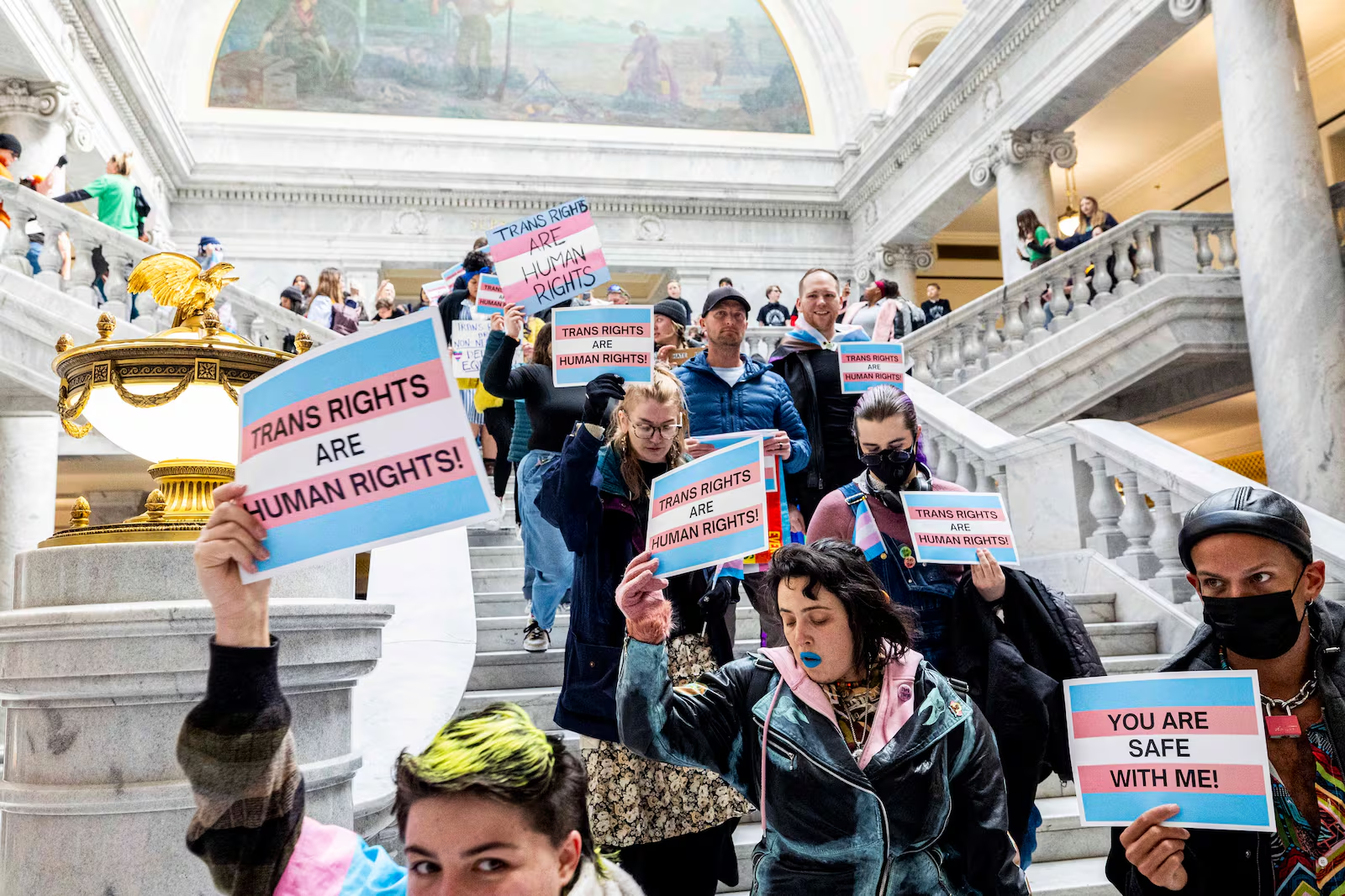

While the Utah Department of Health and Human Services review states that hormonal transgender treatments are “generally safe,” a peer-reviewed report published by the U.S. Department of Health and Human Services in November found significant risks associated with puberty blockers and cross-sex hormones.
Puberty blockers decrease bone mineral density during an essential time for bone development, which can cause osteoporosis. They also halt the maturation of sex organs, which can lead to permanent sexual dysfunction and infertility, particularly if followed by cross-sex hormones.
The effect of puberty blockers on neurological development is uncertain because of a lack of data, the U.S. HHS report found. However, increasingly, studies show the impact of sex steroid hormones on brain development connected to emotional regulation and intelligence quotient.
“The (Utah DHHS review) itself was commissioned to be a systematic medical evidence review, but it is just not that at all,” Do No Harm medical director Kurt Miceli told the Deseret News.
“We’ve got to do all we can to keep kids safe, to promote their well being, and that’s not through these procedures that don’t have really any degree of evidence to support them.”
Bill sponsors and university respond
As a practicing family physician, 3rd District Rep. Kennedy spearheaded Utah’s transgender legislation in 2023, making Utah the fifth state in the country to ban hormonal transgender treatments for children, and making him the target of vandalism by opponents of the bill.
Kennedy said he was motivated by a desire to protect children from irreversible treatments in an area of medicine with very little long-term data. He had hoped that commissioning a systematic review of the evidence would help to inform future policies, but the Utah DHHS review “has flaws,” Kennedy said.
The ban on transgender treatments for children is already “permanent” unless the Legislature acts to lift it, Kennedy said. Framing it as a moratorium was important to passing the bill because some lawmakers wanted more data on the effects of puberty blockers and cross-sex hormones, Kennedy said.
While nearly two dozen states have now followed Utah’s lead, Kennedy said he is proud of Utah’s law because it has yet to be litigated. But he worries a federal bill that would criminalize transgender treatments for minors could undo his work in Utah.
On Dec. 18, Kennedy became one of four Republicans to oppose the “Protect Children’s Innocence Act” because he said he worried it would preempt Utah’s legislation, potentially leaving the state with no restrictions at all if the federal law were to be enjoined in court.
Kennedy’s co-sponsor, Rep. Hall, R-South Ogden, told the Deseret News via email she believes the moratorium should be made permanent. The Utah Department of Health and Human Services review only highlighted how small sample sizes, reliance on self-reporting and lack of randomized trials result in low-quality evidence, she said.
In a statement to the Deseret News, a spokesperson for University of Utah Health defended the review they conducted on behalf of the Utah Department of Health and Human Services, saying the group found “an extensive body of research regarding the safety and efficacy of these treatments.”
“Our review also found that the consensus of that evidence is that the treatments are safe in terms of changes to bone density, cardiovascular risk factors, and metabolic changes; and they are effective in terms of positive mental health and psychosocial outcomes.”
The Utah Department of Health and Human Services review included multiple advisers who have previously advocated on behalf of gender-related treatments.
Dr. Nicole Mihalopoulos, the chief of adolescent medicine at the University of Utah, lists “transgender healthcare” as one of her special interests, has treated patients who received transmasculine top surgery and has published an academic article arguing that state governments “actively resist efforts promoting equal rights” for “transgender/gender diverse youth.”
Dr. Brooks Keeshin, the associate vice chair of research in child mental health at the University of Utah, published an academic article in October 2024 arguing that the systematic review requested by SB16 could reopen a “limited pathway” for adolescent Utahns to receive “gender-affirming care” in the future.
These ties to child transgender treatments were not disclosed along with other potential conflicts of interest which were disclosed in the Utah DHHS review.
Is Utah DHHS on board?
In recent years, Utah has banned DEI initiatives in public institutions, and blocked transgender access to single sex public bathrooms and high school sports. But Do No Harm’s investigation suggests there may be opposition to these policies within state health agencies.
In one of several such email exchanges obtained by Do No Harm through a government records request, an unnamed Utah Department of Health and Human Services employee is quoted by public information officer Charla Haley in January 2024 as asking why more is not being done “to push back against” policies to remove pro-DEI, and gender-related language from state resources.
“This effort to remove references to health equity, race, gender identity, ethnicity, and sexual orientation is reprehensible censorship that invisibilizes communities who have already experienced disproportionate negative health outcomes from systemic oppression,” the email said.
This is an example of “political ideologues” within the Utah Department of Health and Human Services “pushing against what the governor, and what the DHHS was aiming to do,” Miceli said, “which fits a broader trend in states across the country, as well as professional associations, of a progressive ‘expert class’ trying to influence policymakers.”
“I have a deep concern about the administrative state … and how they allow their own personal ideology to influence the day-to-day work that they’re doing,” Kennedy told the Deseret News. “And in my opinion, the administrative state should follow the Legislature and not the reverse.”
Hall shared this concern of public employees potentially “trying to circumvent state law.” In 2024, it was reported that a long-awaited National Institutes of Health study of child transgender treatments was not published because it did not show mental health improvements, Hall pointed out.
The unwillingness of American medical elites to slow the application of child transgender treatments is unique.
While transgender treatments are supported by groups like the American Academy of Pediatrics, the American Psychological Association and the Endocrine Society, six European nations, including Finland, Norway and Sweden have recently limited hormonal transgender treatments for children.
England and Scotland joined these countries in 2024 after the release of the “Cass Review,” which found a lack of reliable evidence for informed clinical decisions, “unclear” rationale for prescribing early puberty suppression and “unknown” effects of cross-sex hormones on minors.
When SB16 passed, it enjoyed the support of 54% of Utahns, according to a Deseret News/Hinckley Institute of Politics poll.
A New York Times/Ipsos survey conducted in January 2025 found 71% of American adults said no one under 18 should have access to hormonal transgender treatments.