6 historical mysteries that scientists finally cracked in 2023 — and one they didn’t
Dec 23, 2023, 9:00 AM | Updated: May 28, 2024, 10:40 am
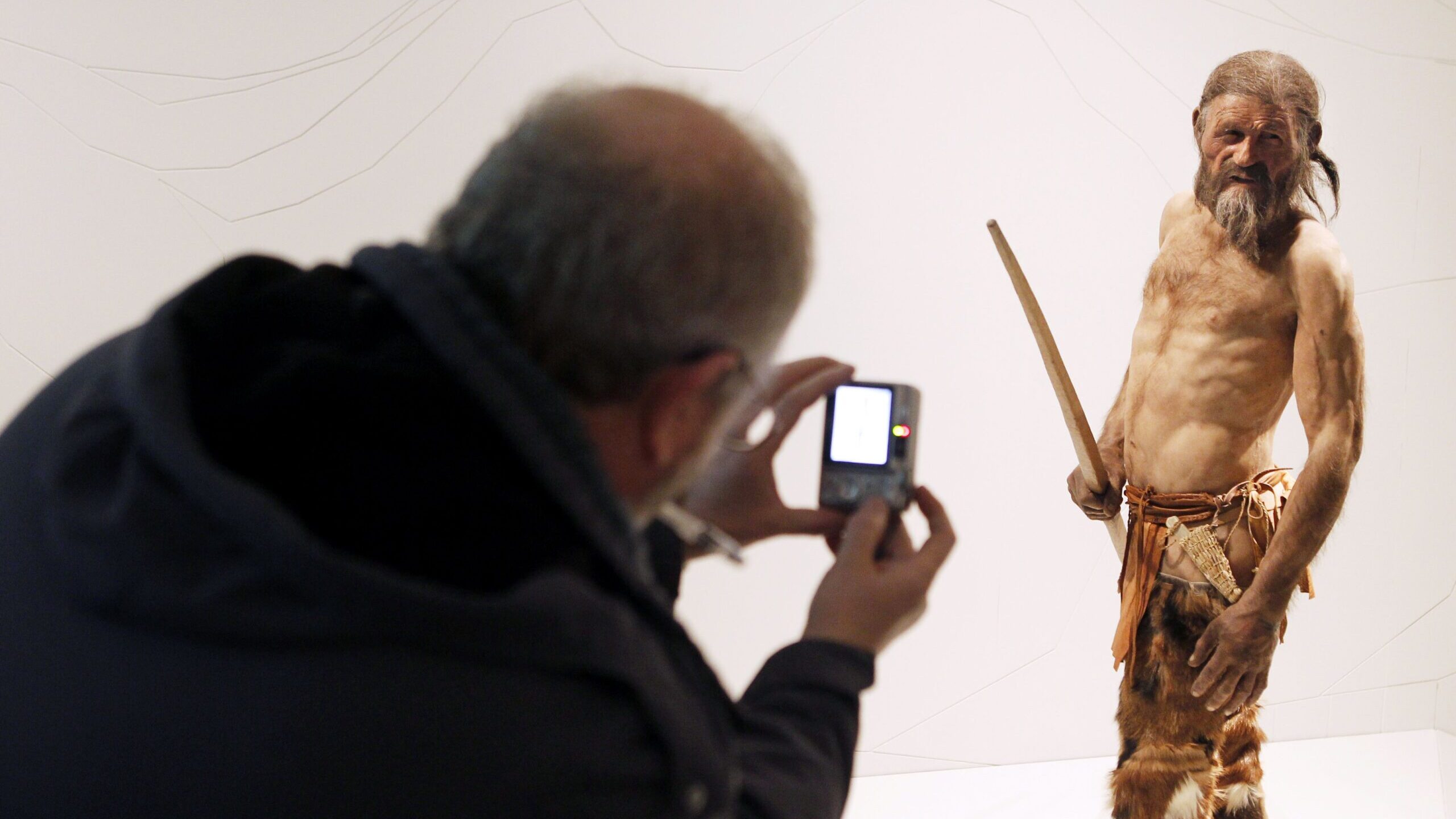
Scientists have revealed the true appearance of Otzi the iceman, whose mummified remains were discovered on 1991 in the Italian alps. (Andrea Solero/AFP/Getty Images
Editor’s note: Ashley Strickland and Taylor Nicioli contributed to this report.
(CNN) — Science is revolutionizing our understanding of the past.
Paleogenetics teases out astonishing secrets from DNA hidden in bones and dirt. Artificial intelligence decodes ancient texts written in forgotten scripts. Chemical analysis of molecular residues left on teeth, cooking pots, incense burners and building materials reveals details about past diets, smells and construction techniques.
Here are six mysteries about human history that scientists have cracked in 2023. Plus, one that still has researchers scratching their heads.
The true identity of a prehistoric leader
Buried with a spectacular crystal dagger and other precious artifacts, the 5,000-year-old skeleton discovered in 2008 in a tomb near Seville, Spain, was clearly once someone important.
The individual was initially thought to be a young man, based on analysis of the pelvis bone, the traditional way scientists determine the sex of human skeletal remains.
However, an analysis of tooth enamel, which contains a type of protein with a sex-specific peptide called amelogenin, determined that the remains were female rather than male.
In other studies, the technique has also dispelled the cliché of “man the hunter” that has informed much thinking about early humans.
“This technique, we think, is going to open up an entirely new era in the analysis of the social organization of prehistoric societies,” Leonardo García Sanjuán, a professor of prehistory at the University of Seville, told CNN in July when the discovery was made public.
The ingredient behind Roman concrete’s legendary strength
Roman concrete has proven to be longer-lasting than its modern equivalent, which can deteriorate within decades. Take, for example, the Pantheon in Rome, which has the world’s largest unreinforced dome.
Scientists behind a study published in January said they had discovered the mystery ingredient that allowed the Romans to make their construction material so durable and to build elaborate structures in challenging places such as docks, sewers and earthquake zones.
The study team analyzed 2,000-year-old concrete samples that were taken from a city wall at the archaeological site of Privernum in central Italy and are similar in composition to other concrete found throughout the Roman Empire.
They found that white chunks in the concrete, referred to as lime clasts, gave the concrete the ability to heal cracks that formed over time. The white chunks previously had been overlooked as evidence of sloppy mixing or poor-quality raw material.
The actual appearance of Ötzi the Iceman
Hikers found the mummified body of Ötzi in a gully high in the Italian Alps in 1991. His frozen remains are perhaps the world’s most closely studied archaeological find, revealing in unprecedented detail what life was like 5,300 years ago.
His stomach contents have yielded information on what his last meal was and where he came from, while his weapons showed he was right-handed, and his clothes provided a rare look at what ancient people actually wore.
But a new analysis of DNA extracted from Ötzi’s pelvis revealed in August that his physical appearance wasn’t what scientists first thought.
The study of his genetic makeup showed that Ötzi the Iceman had dark skin and dark eyes — and was likely bald. This revised appearance stands in stark contrast to the well-known reconstruction of Ötzi that depicts a pale-skinned man with a full head of hair and a beard.
The wearer of 20,000-year-old pendant revealed
Archaeologists frequently unearth bone tools and other artifacts from ancient sites, but it’s been impossible to know for sure who once used or wore them.
Earlier this year, scientists recovered ancient human DNA from a pendant made from deer bone found in Denisova Cave in Siberia. With that clue, they were able to reveal that its wearer was a woman who lived between 19,000 and 25,000 years ago.
She belonged to a group known as Ancient North Eurasians, which have a genetic connection to the first Americans.
Human DNA was likely preserved in the deer bone pendant because it is porous and therefore more likely to retain genetic material present in skin cells, sweat and other body fluids.
It’s not known why the deer tooth pendant contained such a large amount of the ancient woman’s DNA (about the same amount as a human tooth). Perhaps it was well-loved and worn close to the skin for an exceptionally long period, said Elena Essel, a molecular biologist at the Max Planck Institute for Evolutionary Anthropology in Leipzig, Germany, who developed a new technique to extract the DNA.
The ancient, damaged scroll decoded by AI
Some 1,100 scrolls were burned to a crisp during the famous eruption of Vesuvius nearly 2,000 years ago. In the 1700s, some enterprising diggers recovered the huge cache from volcanic mud.
The collection, known as the Herculaneum scrolls, is perhaps the largest known library from classical antiquity, but the contents of the fragile documents remained a mystery until a University of Nebraska computer science student won a scientific contest earlier this year.
With the help of artificial intelligence and imaging by computerized tomography, Luke Farritor was the first to decode a word written in ancient Greek on one of those blackened scrolls.
Farritor was awarded $40,000 for deciphering the word “πορφυρας” or “porphyras,” which is the Greek word for purple. Researchers are hopeful that it won’t be long until entire scrolls can be deciphered using the technique.
The materials necessary for making a mummy
From fragments of discarded pots in an embalming workshop, scientists have discovered some of the substances and concoctions ancient Egyptians used to mummify the dead.
By chemically analyzing organic residues left in the vessels, researchers determined that ancient Egyptians used a wide variety of substances to anoint the body after death, to reduce unpleasant smells and to protect it from fungi, bacteria and putrefaction. Materials identified include plant oils such as juniper, cypress and cedar, as well as resins from pistachio trees, animal fat and beeswax.
While scholars had previously learned the names of substances used to embalm the dead from Egyptian texts, they were — until recently — only able to guess at exactly what compounds and materials they referred to.
The ingredients used in the workshop were varied and sourced not just from Egypt, but much farther afield, suggesting the long-distance exchange of goods.
Beethoven: A family secret revealed — but one mystery endures
Composer Ludwig van Beethoven died at the age of 56 in 1827 after a string of chronic health problems, including hearing loss, gastrointestinal issues and liver disease.
Beethoven wrote a letter to his brothers in 1802 asking that his doctor, Johann Adam Schmidt, investigate the nature of the composer’s illnesses once he died. The letter is known as the Heiligenstadt Testament.
Nearly 200 years after his death, scientists extracted DNA from preserved locks of hair in an attempt to honor this request.
The team was not able to come up with a definitive diagnosis, but Beethoven’s genetic data helped the researchers rule out potential causes of his ailment such as the autoimmune condition celiac disease, lactose intolerance or irritable bowel syndrome.
The genetic information also suggested an extramarital affair had taken place in the composer’s family.
The-CNN-Wire
™ & © 2023 Cable News Network, Inc., a Warner Bros. Discovery Company. All rights reserved.