Hubble telescope captures images of changes to Jupiter and Uranus
Mar 29, 2023, 5:00 AM | Updated: 9:02 am
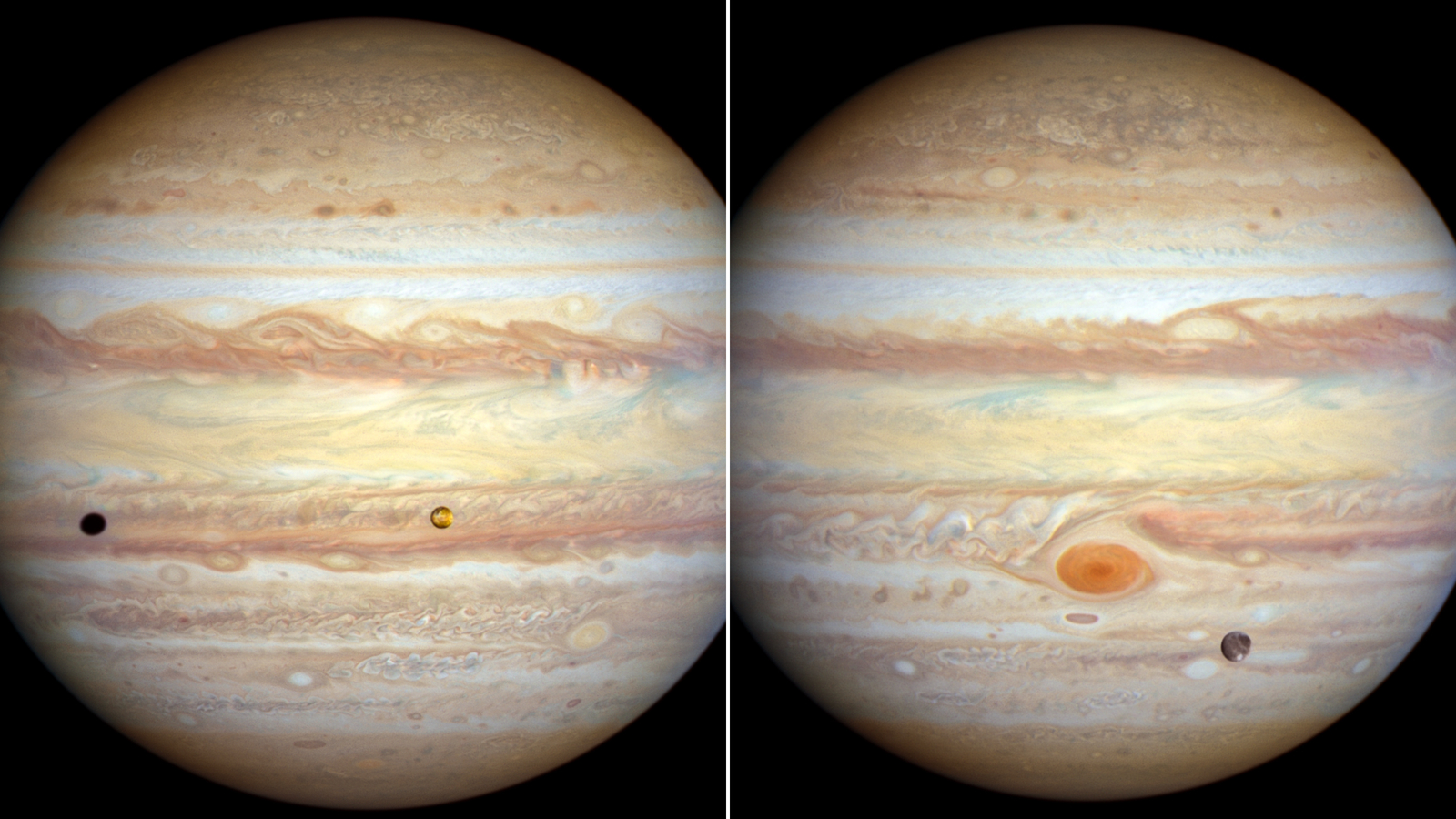
The Hubble Space Telescope captured these images of Jupiter. (From left) In November 2022, storms form a wave pattern. A January 2023 view shows the Great Red Spot, as the moon Ganymede transits (lower right). Photo credit: NASA
(lower right)
(CNN) — The weather is slowly changing on Jupiter and Uranus, according to our galaxy’s own interplanetary meteorologist.
The NASA Hubble Space Telescope captured Earth’s outer planetary neighbors in images from 2014 to 2022, documenting changes in the planets’ weather and seasons over time.
With Jupiter at about 484 million miles (779 million kilometers) away from our sun and Uranus about 1.8 billion miles (3 billion kilometers) away, each takes longer to orbit the sun, which means a slower pace of seasons. But the gas giants still experience extreme weather. That’s especially true for Uranus, with its peculiar, tilted axis that causes one hemisphere to be completely without sunlight for about 42 years at a time.
In Hubble’s November 2022 image of Uranus, the planet’s north pole has a large off-white circle, caused from a thickened photochemical haze that resembles the smog produced over cities, alongside several storms near the circle’s edge, according to NASA.
In one of the first images of the Hubble Space Telescope’s Outer Planet Atmospheres Legacy, or OPAL, Program, the north polar cap of Uranus appears to be brighter compared with its appearance in a November 2014 image. A NASA research team is tracking the size and brightness of the north polar cap and reporting that the haze appears to get brighter each year.
“The view I always had of the planets when I was a kid was that they were very static. You had a textbook picture; you didn’t see them change. And of course, that’s not true. These are gigantic atmospheres, they’re changing all the time,” said Dr. Amy Simon, the senior scientist for Planetary Atmospheres Research at NASA, who was involved with these Hubble observations.
“For us to be able to understand the processes going on, we just need more time coverage. A year on Jupiter takes 12 Earth years, and it just gets worse from there. We’re trying to build up this database so we can understand the processes going on in these atmospheres.”
Monitoring atmospheric changes
The OPAL project’s goal is to obtain observations of the outer planets to help scientists better understand their atmospheric dynamics and evolution. Since following Uranus’ polar cap and how it changes with the seasons, scientists had found that neither pole was bright during the planet’s equinox in 2007, when it was fully illuminated by the sun.
In 2028, when the northern summer solstice approaches, NASA scientists predict the cap will grow even brighter, and will give the Hubble a clear view as Uranus’ north pole will be aimed directly toward Earth.
“If you think back to the original Voyager pictures of Uranus, it was just kind of a pale blue ball with nothing on it. You didn’t see clouds, you didn’t see haze, you didn’t see anything … so there was a polar cap then, but we couldn’t see it,” Simon said. “What we’ve been watching over time (using Hubble), is this buildup of this high-altitude haze in the atmosphere, and the exact purpose or the exact mechanism behind it, we don’t know, that’s one of the things we’re studying.”
Great Red Spot storm system
In a January image of Jupiter, the planet’s Great Red Spot is in the limelight. The spot, which is actually a gigantic, centuries-old storm, stands out next to one of Jupiter’s moons, called Ganymede. It’s the solar system’s largest moon and slightly bigger than the planet Mercury.
This Hubble image shows that the Great Red Spot is big enough to swallow Earth, according to NASA.
While the vortex is mighty, scientists have observed the spot shrinking over the years and reported it to be at the smallest size it has ever been, according to records including data going back 150 years.
Jupiter’s increasing storm activity
At the launch of Hubble in 1990, no cyclones or thunderstorms were detected on Jupiter. But in the past decade, the storms have increased, with a string of storms visible in both images during November 2022 and January 2023. If the storms get close enough to one another, they could merge to potentially form a massive storm that is even bigger than the size of the Great Red Spot, according to NASA.
“We’ve gotten quite used to seeing a lot of big change on Jupiter. We see the clouds change color, we see storms coming, we’ve been watching the Great Red Spot — I would love to see a big storm outbreak on Uranus, because that’s one of the few places where we don’t tend to see that very much,” Simon said. “If we saw a big storm develop on Uranus (using Hubble), I’d be pretty excited.”
With Hubble, scientists are able to closely monitor the ever-changing atmospheres of these outer planets. “Hubble’s sharpness and sensitivity keeps an unblinking eye on a kaleidoscope of complex activities over time,” according to NASA’s statement.