SCIENCE + TECHNOLOGY

New study challenges a site that’s key to how humans got to the Americas

Mar 19, 2026, 4:22 PM
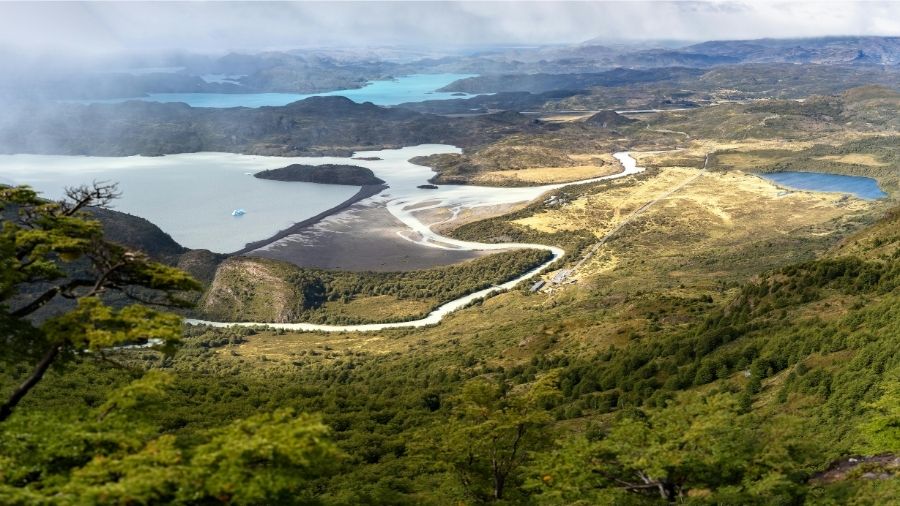
Scenic Aerial View of Torres del Paine, Chile. (Marek Piwnicki, Pexels, Canva) Americas...

Scenic Aerial View of Torres del Paine, Chile. A new discovery in the country offers a new potential explanation to the origins of humanity on the American continents.(Marek Piwnicki, Pexels, Canva)

(Marek Piwnicki, Pexels, Canva)

NEW YORK (AP) — For decades, the strongest evidence for the earliest human settlement in the Americas came from a site in Chile called Monte Verde.

Scientists found echoes of human presence dating back to around 14,500 years ago, including footprints, wooden tools, foundations for a building and the remains of an ancient fire pit. They dated sediments and artifacts from the site to this time frame.

A new study challenges the age of this important site, suggesting Monte Verde might be much younger than scientists thought. But not everyone agrees with the findings.

Scientists sampled and dated sediments from nine areas along the Chinchihuapi Creek by the site and analyzed how the landscape changed over thousands of years. They uncovered a layer of volcanic ash from an eruption dating back to about 11,000 years ago.

Anything above that layer — in this case, the Monte Verde wood and artifacts — had to be younger, according to study co-author Claudio Latorre.

“We basically reinterpreted the geology of the site. And we came to the conclusion that the Monte Verde site cannot be older than 8,200 years before present,” said Latorre, who works at the Pontifical Catholic University of Chile.

The researchers think changes to the landscape, including a stream wearing down the rocks, may have mixed old layers with new, causing researchers to date ancient wood as part of the Monte Verde site.

The findings were published Thursday in the journal Science. Several scientists, including those involved with the original excavations, take issue with the results.

“They have provided, at best, a working hypothesis that is not supported by the data they presented,” said Michael Waters of Texas A&M University, who had no role in either study.

Experts not involved with the research say the study includes analysis of samples from the area surrounding Monte Verde, where the geology isn’t comparable to the site itself. And they say there’s not enough evidence that the layer of volcanic ash once covered the entire landscape.

They also say the study doesn’t offer a sufficient explanation for the artifacts found at the site that have been directly dated to 14,500 years ago, including a mastodon tusk fashioned into a tool, a wooden lance and a digging stick with a burned tip.

“This interpretation disregards a vast body of well-dated cultural evidence,” archaeologist Tom Dillehay of Vanderbilt University, who led the site’s first excavation, said in an email.

The new study’s authors disagree with these criticisms, saying they sampled within, upstream and downstream of the site. And there’s not enough evidence that the dated artifacts at the site really are that old, said co-author Todd Surovell, of the University of Wyoming.

The Monte Verde site is critical to scientists’ understanding of how people got to the Americas. Scientists used to think the first arrivals were a group of people 13,000 years ago who made tipped stone tools known as Clovis points. The discovery and dating of Monte Verde, which was initially mired in controversy, appeared to put that to rest.

It’s unclear how a new date for the site might affect the human story. Since Monte Verde, researchers have uncovered sites in North America that predate the Clovis people, such as Cooper’s Ferry in Idaho and the Debra L. Friedkin site in Texas.

But another big question is how, exactly, people got to the Americas from Asia, maneuvering south of two massive ice sheets covering Canada. Did humans arrive in time for the sheets to part, revealing an ice-free corridor? Did they travel along the coast in boats, or over a mix of water and land?

A revised date for Monte Verde could reopen discussions about the most likely route by early humans, said Surovell. Future independent analyses of other early human sites could provide more clarity.

“Given enough time and given the ability to do science, science is self-corrective,” Surovell said. “It eventually reaches the truth.”


The Associated Press Health and Science Department receives support from the Howard Hughes Medical Institute’s Department of Science Education and the Robert Wood Johnson Foundation. The AP is solely responsible for all content.

Read more: Potential conflicts over celebrating America’s 250th anniversary spill out in congressional hearing


We want to hear from you.

Have a story idea or tip? Send it to the KSL NewsRadio team here.

Science + Technology

FILE - The OpenAI logo is seen displayed on a cell phone in Boston. OpenAI said it is still investi...

Matt O'Brien, AP Technology Writer

OpenAI blamed a hacking event on its AI models going rogue. Here are some things to know

ChatGPT maker OpenAI says it is still investigating the “unprecedented cyber incident” that led its artificial intelligence systems to break out of a testing environment and hack into another AI company. OpenAI said Tuesday two of its most capable AI models were responsible for the cyberattack targeting AI startup Hugging Face. The incident is stirring debates over the need […]

2 days ago

FILE: Massive antennas, part of the Atacama Large Millimeter/ submillimeter Array (ALMA) radio tele...

Adithi Ramakrishnan, AP Science Writer

In a sweet discovery, astronomers find sugar lurking in the space between stars

Astronomers have detected a type of sugar, called erythrulose, in space that's also found in raspberries and self-tanners.

10 days ago

During a meeting of the Cache County Council on June 23, county official Brian Abbott presented a p...

Bryanna Willis

Cache County Council joins other Utah counties by placing a hold on data center approval

The Cache County Council has placed a temporary pause on approving data centers while city officials look into a data center's impact.

23 days ago

After the defeat of three Utah leaders who helped move the Stratos data center project forward, a r...

Tim Vandenack, KSL

Data center developers move forward despite voter backlash aimed at Sen. Adams, others

After the defeat of three Utah leaders who helped move the Stratos data center project forward, a rep from O'Leary Digital, the firm spearheading the plans, says the efforts will continue.

29 days ago

FILE - Computer scientist Fei-Fei Li speaks during the Clinton Global Initiative, Sept. 24, 2024, i...

Matt O'Brien, AP Technology Writer

All the world’s a robot-staging ground for tech entrepreneurs building ‘physical AI’

A growing number of AI entrepreneurs are dedicating themselves to models that teach AI systems how to react in a physical environment.

30 days ago

Sen. John Curtis speaks at the Scott C. Keller Business Building at UVU in Orem On May 4. Curtis in...

Cami Mondeaux, Deseret News

Kids are talking to AI more than ever. John Curtis wants rules to ensure their safety

Sen. John Curtis introduced a bipartisan bill on Tuesday to establish a federal framework regulating online chatbots, particularly as it relates to usage by teenagers and young children.

1 month ago

Sponsored Articles

...

Bear Lake

Road trip ready: How Bear Lake became the go-to destination for Western U.S. travelers

Whether you are chasing pristine beaches, fresh raspberry shakes, or endless water sports, this sponsored guide—brought to you in partnership with Bear Lake —uncovers everything you need to plan the ultimate getaway.   There’s nothing quite like the thrill of hopping in the car with your favorite snacks in tow and heading out for a […]

...

Harper Clinic

A new standard of care: How Harper Clinic’s IOP is changing the face of mental health treatment in Utah

This article is sponsored by Harper Clinic, a Utah-based clinic offering FDA-approved TMS therapy for treatment-resistant depression.    Utah’s mental health crisis is leaving many residents caught in an uncomfortable middle ground: struggling too much for weekly therapy alone, but unable to step away from work, parenting or daily life for inpatient treatment. As demand […]

...

Harper Clinic

Breaking free from depression: How Harper Clinic’s TMS Therapy can help

This article is sponsored by Harper Clinic, a Utah-based clinic offering FDA-approved TMS therapy for treatment-resistant depression.    The weight of depression is real. Many people spend years fighting it, adjusting medications, managing side effects and wondering if this is simply how life is going to feel.   According to the World Health Organization, depression affects […]

mental health...

Andrew Adams, KSL

Library discussions bring men’s mental health to the surface

Therapists say it’s common for men to repress things like trauma, grief, stress and anxiety. Now, a new weekly series of discussions aims to help men bring it all to the surface.

...

Bear Lake Convention & Visitors Bureau

Cozy up in Bear Lake: Discover the magic of a winter getaway

SALT LAKE CITY – The holiday season shines brightest when time slows down and loved ones gather. Gifts, decorations and festive music come and go, but shared experiences tend to last much longer. Research supports that idea. Dr. Theresa E. DiDonato told Psychology Today that vacations can strengthen relationships by creating meaningful time away from daily […]

...

Harper Clinic

Rewriting the path to healing: Inside Harper Clinic’s whole-person mental health model

OREM — A few decades ago, you’d have had a hard time finding a doctor to treat both your mind and body; And a century ago, you’d have been hard-pressed to find a doctor to treat your mind at all. Today, medical professionals are understanding more and more the undeniable connection between the body and […]

New study challenges a site that’s key to how humans got to the Americas