AI deepfake media can sway public opinion as effectively as real media, UVU study finds
Jun 20, 2026, 3:00 PM
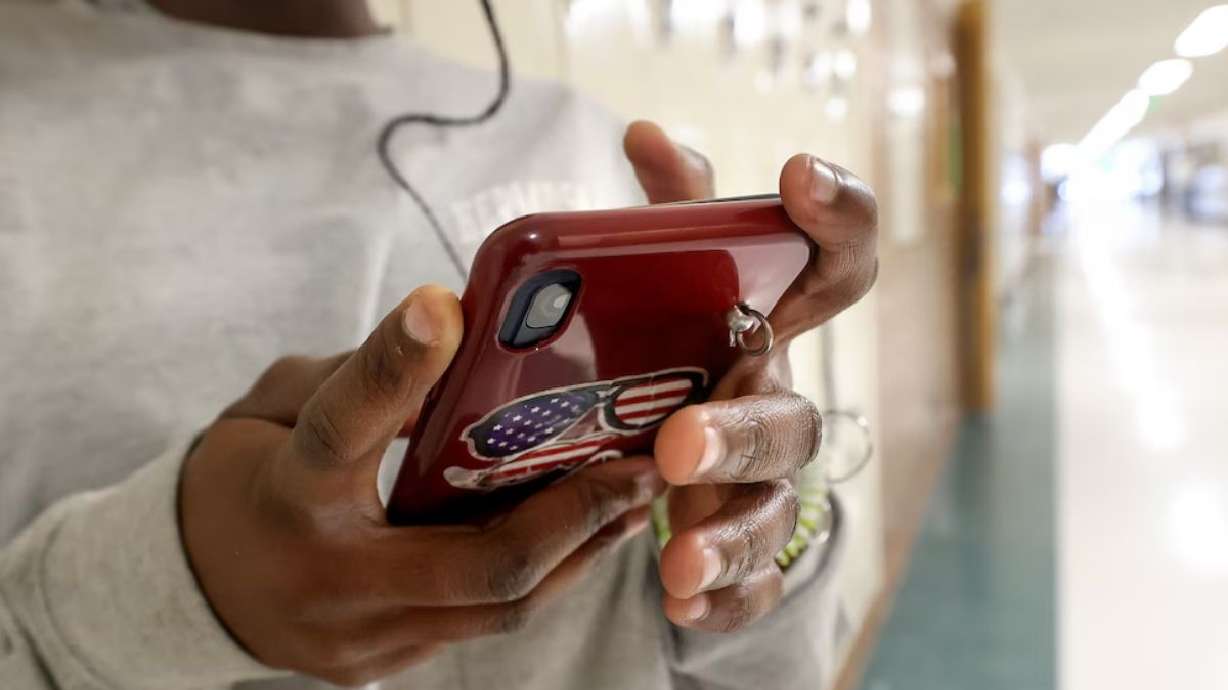
An eighth grader uses their cellphone after school at Evergreen Junior High School in Millcreek on Jan. 10, 2024. A UVU study found that deepfake media can sway public opinion just as effectively as real media, impacting elections at every scale. (Kristin Murphy, Deseret News)
(Kristin Murphy, Deseret News)
OREM — The approach of midterm elections has reawakened a reality of election season most people dread: political ads.
They dominate our TVs, computers, radio stations and podcasts, to name a few modes of consumption.
But this year, they have a different, noticeably more sinister twist that can likely be attributed to the meteoric rise in AI-generated deepfake content.
A particular instance that has garnered significant attention is a series of deepfake ads targeted against Texas Rep. James Talarico, the Democratic U.S. Senate nominee.
NEW: The Trump-aligned org Citizens for Sanity is dropping a six-figure ad buy in the Texas Senate race.
The ad is a 15 second clip of AI-generated James Talarico singing a “trans kids” rendition of “Favorite Things.”
Obtained first by @DailyCaller: pic.twitter.com/JNY8vxYueG
— Reagan Reese (@reaganreese_) June 9, 2026
The Citizens for Sanity deepfake was followed by another AI-generated deepfake posted by the official Senate Republicans X account, days later. In it, an AI-generated Talarico read old tweets out loud.
James Talarico, in his own words: pic.twitter.com/lDlUoqBbP7
— Senate Republicans (@NRSC) March 11, 2026
According to Ballotpedia, as of April 2026, 31 states have enacted laws related to deepfakes used in political communications. In more than half of these states, the law applied to political materials distributed within a certain number of days before an election, and most included exceptions for materials containing a disclosure statement, with varying degrees of specificity regarding what that statement must say and how it must be presented.
But the generally off-putting and creatively lacking nature of these political deepfake ads is far from the scariest thing about them.
A study from Utah Valley University’s Gary R. Herbert Institute for Public Policy released Thursday found that deepfake media can sway public opinion just as effectively as real media, impacting elections at every scale.
To conduct the study, the research team created a handful of deepfake videos, which they tested on 632 participants on an online survey platform, using a representative sample of U.S. citizens.
Participants were shown a fictional ballot initiative and asked how they would vote — yes, no, or neutral.
Then, participants were shown one of four videos, two of which were real and two of which were fake (the teams created a real video and a fake video to argue both for and against the fictional initiative).
After viewing the video, participants were again asked how they would vote on the initiative.
“We found no statistically significant difference in the opinion changes of people who saw a real versus a synthetic video. This shows just how successful deepfake disinformation operations could be,” Kaye Banner, a student researcher, said.
The study also asked participants to rate the credibility of the video they were shown based on the perceived trustworthiness, knowledge and persuasiveness of the speaker that they saw.
The result? Deepfake videos got equal or even higher credibility scores compared to their real counterparts, Banner said.
Perhaps most surprising, the study also found that no one, regardless of political affiliation or other demographic factors, can reliably identify a deepfake.
In fact, the study also demonstrated that participants with the highest confidence in their own judgement were three times as likely to be incorrect in correctly identifying the media they were shown.
“If you think you’re too smart to be deceived, you are the perfect target for these deepfakes,” Banner said.
Almost 60% of people who saw a deepfake video said that it was real. And even real videos were only identified as being authentic 50% of the time, with the rest of the participants thinking it was fake or unsure of what they saw.
So, what does this mean for actual policy?
Brandon Amacher, director of the Emerging Tech Policy Lab and an instructor of national security at UVU, said the revelations from the study have “real consequences” to how responsibility is delegated in the fight against deepfakes, specifically in political contexts.
With the study showing that no one can really identify deepfakes with any meaningful accuracy, Amacher said the discussion must shift beyond individual responsibility.
“Platforms that host and distribute this content and the policymakers that regulate them need to build out the other layers: providence labeling, watermarking, digital identity, faster detection and takedown for disinformation campaigns and legal frameworks that directly address the deliberate use of synthetic media to sway voter opinion,” Amacher said.
“None of these solutions will eliminate the risk on their own. There is no silver bullet to solve this problem and I’m not here to hand you a finished policy. I’m here to tell you that meeting this threat is going to take individuals, platforms, and policymakers all moving together to cover the ground that each cannot cover on their own,” he added.
The full study can be found here.