Mayor of Clinton City faces criticism for allowing fireworks
Jul 2, 2026, 6:12 PM | Updated: Jul 6, 2026, 2:25 pm

Fireworks for sale at Mad Matt's Fireworks in Sandy on Tuesday, June 30, 2026. A little to the north, in Clinton, Utah, the mayor is being criticized for allowing fireworks in certain areas of the city. (Tess Crowley, Deseret News)
(Tess Crowley, Deseret News)
Editor’s note: This story was adapted from a radio broadcast script using artificial intelligence. Every story, including those adapted with AI, is reviewed by a human editor before publication to ensure that KSL’s editorial standards are upheld
SALT LAKE CITY — Mayor Marie Dougherty of Clinton City said the public has been quick to react to her recent decision not to implement a citywide ban on fireworks. The feedback came from all fronts: in person, over social media, through voicemails and email.
“We’re ‘just going rogue,’ we’re ‘not answering the call,’ we’re ‘defying the ban,’” Dougherty said, repeating some of the criticism. “I’ve just been hammered by people all over the state, screaming at me that I am the most horrible, disgusting person.”
Other reading: Utah Highway Patrol launches holiday DUI crackdown and Lyft program
What’s extra frustrating, Dougherty said, is she feels like her decision is completely misunderstood.
“It was important to us to not make our decision based on passion, emotion or political or public perceptions,” she said, “and instead to make our decision based on the facts that boots-on-the-ground expertise would conclude.”
Officials in Clinton were some of the first to announce they would opt for fireworks restrictions, rather than an all-out ban, after Utah Gov. Spencer Cox declared a state of emergency on June 25. The governor’s actions temporarily suspended state statutes, which allowed the state forester to enact a statewide ban on personal fireworks from July 2 through July 5. But Dougherty said it was not a decision that came lightly, and that the city did a lot of research before making the call.
“We had our fire chief drive around the city and analyze all of our local conditions,” she said. “And he talked to neighboring jurisdictions and their fire chiefs just so that we could all be on the same page with regard to our conditions, our resources and our access to those resources.”
Dougherty said the city’s fire chief looked at things like current conditions, historical data, dryness and high-risk areas.
“And after his analysis, he was able to determine that Clinton is not at any greater risk than previous years with regard to fire,” she said. “And we particularly have no risk of wildfire.”
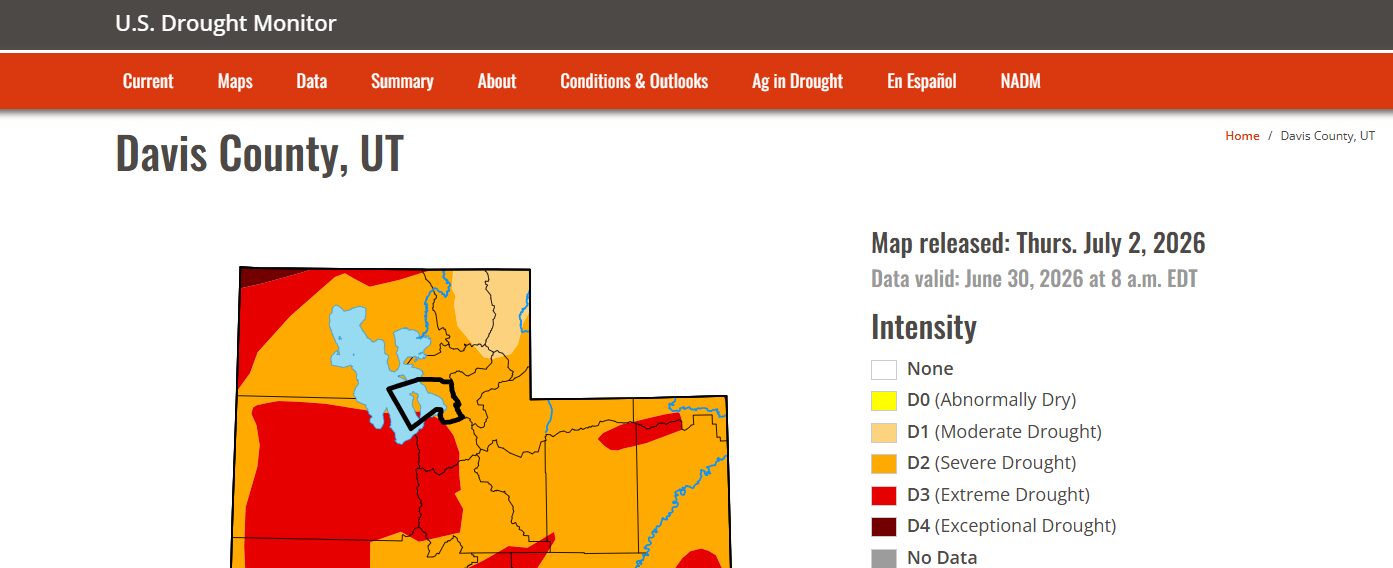
Screengrab from U.S. Drought Monitor (https://droughtmonitor.unl.edu/CurrentMap/StateDroughtMonitor.aspx?fips_49011, accessed July 2, 2026)
Despite the findings, Clinton officials still decided to restrict three times more areas than ever before, including spaces like railroad tracks, the power corridor and open fields. Dougherty said this was simply out of an abundance of caution, but the city doesn’t have a lot of high-risk areas.
“Clinton is basically 6 square miles of residential suburban area, and it has no wildland nearby. We have no foothills, no extensive areas of wilderness to catch fire,” Dougherty said.
The conclusion they reached, she said, was the city’s best attempt to use executive authority properly, without going against the governor’s executive order. In fact, Dougherty said she worked closely with state officials.
“Clinton did not defy the governor’s order in any way. We followed it,” she said. “We were participants right alongside the League of Cities and Towns in the meetings with the state forester and the league. We were right there in all those meetings, listening, learning, being team players, trying to properly execute this order to the best of our ability.”
Dougherty said she had to balance the public’s rights with the city’s conditions and needs — and she said the order was written in a way to ensure cities could do just that. The ban was the default, but it intentionally left the door open for local officials to make the choices best for their jurisdiction.
“The specific provisions allowed local jurisdictions to analyze their own hazards and conditions, and lift the ban when appropriate and necessary in order to ensure proper use of executive authority. We thought that was a smart plan that made sense for the conditions in our state,” she said.
Related: Utah’s Fourth of July events celebrating America 250
“Clinton is very sympathetic to all of the suffering that is going on around the state, and we’re grateful for the governor’s attention to that suffering while still allowing opportunities for cities to assess their local conditions.”
Dougherty said the decision really came down to taking a thoughtful, careful approach to her use of executive power. Something that started with thorough research, and an approach specific to the city of Clinton.
“Anything else, I feel would have been a violation of our sacred trust as individuals tasked with upholding the law, because the legislature has already granted the public the right to launch fireworks,” Dougherty explained. “If we are going to overturn that, we need to have a darn good reason…and in Clinton, we didn’t feel like we could go beyond what the facts, conditions, analysis and expertise told us.”
Dougherty stands by the decision, but emphasized that she is putting trust in the community to act responsibly.
“We call on all of our residents to use their best judgment, to be respectful to their neighbors and to take a little extra kindness during a very contentious time in our state where there’s a lot of emotion and a lot of sadness,” she said. “We’re really hopeful that our residents are going to rise up and make good choices, and they usually do. We have had very few problems during the week of the Fourth of July and we are expecting no different this year.”
Clinton is not alone in the decision to focus on restrictions, rather than a ban. Nearby cities with similar conditions like Clearfield, South Weber, Sunset and West Point made similar decisions. So did cities in counties ranging from Washington County in southern Utah to Box Elder County in northern Utah.