Feds’ new plan for Lake Powell, Lake Mead not the final ‘destination,’ Utah official says
Jul 31, 2026, 10:59 AM | Updated: Aug 5, 2026, 2:53 pm
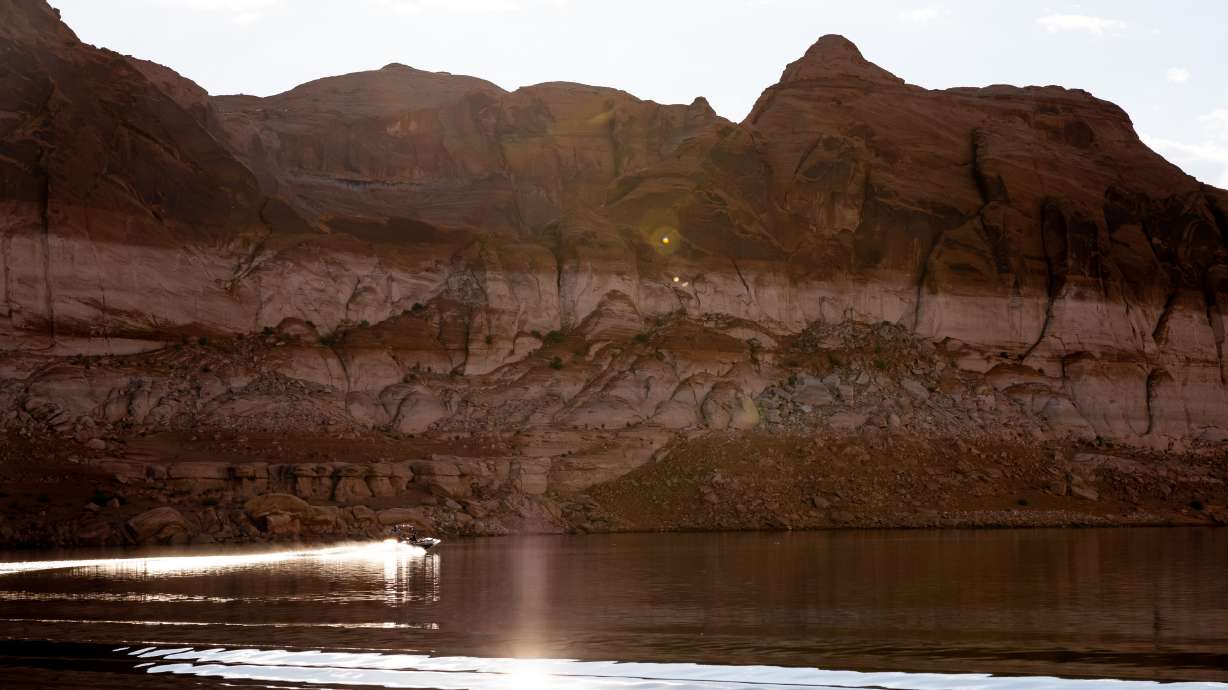
A boat seen against the backdrop of Lake Powell's "bathtub ring," a light-colored coating of mineral deposits left on the canyon walls on Oct. 7. 2022 near Bullfrog. The federal government on Friday released a new management plan for it and Lake Mead. (Spenser Heaps, Deseret News)
(Spenser Heaps, Deseret News)
SALT LAKE CITY — Utah and other Upper Colorado Basin states may voluntarily cut up to 200,000 acre-feet of Colorado River water under a new 10-year deal to handle how to allocate the river’s water.
That’s according to the final draft of the Bureau of Reclamation’s long-awaited post-2026 plan for Lake Powell and Lake Mead, released on Friday. However, Utah’s top Colorado River official insists that it could change, as the seven states that rely on the river continue to seek a consensus agreement, while the state also awaits additional documents tied to the plan.
“(It’s) a bridge, not a destination,” said Gene Shawcroft, chairman of the Colorado River Authority of Utah. “We have a lot of other things that will have to be released in order for us to understand how all the puzzle pieces fit together.”
The main framework of the massive plan relies on “sideboards,” essentially allowing the federal government to adjust Lake Powell and Lake Mead operations depending on the conditions every other year through 2036, beginning next year. Under this, annual releases from Lake Powell, at the Utah-Arizona border, are to be between 5 million and 12 million acre-feet
The Lower Basin’s usage could be cut by as much as 3 million acre-feet, but states can store between 3 million acre-feet and 8 million acre-feet of conserved water within both Lake Powell and Lake Mead for future use. The Upper Basin’s voluntary cuts are subject to hydrology, the agency noted.
It replaces an agreement that has been in place since 2007, but states have struggled to reach a full allocation because of poor hydrologic conditions.
“This framework provides the flexibility to respond to changing hydrologic conditions while preserving the opportunity for the basin states to continue working toward durable, consensus-based solutions,” Interior Secretary Doug Burgum said in a statement.
Shawcroft was still sifting through the 2,600-page document Friday afternoon, but, preliminarily, he said it appears that the federal government’s preferred course aligns with the best outcome for Utah, among other options that could have been implemented.
The Colorado River accounts for a little more than a quarter of Utah’s water supply, but approximately one-third of the state’s drinking water also comes from it, according to the Utah Division of Water Resources. It estimates 60% of the state benefits from it altogether.
The new agreement, he explained, seems to side with the reality that the river’s declining hydrology needs to be addressed, not the demands by each state, which the outgoing agreement did.
“I’m grateful that the statement recognizes, clearly, the need to develop a system that’s based on what water is available, not what water is demanded,” Shawcroft said.
How we got here
Between 2020 and 2024, the Lower Basin used 6.5 million acre-feet of its water annually, nearly half of the 13.1 million acre-feet production. The Upper Basin’s 3.8 million acre-feet accounted for another 29%, while the rest either made it to Mexico or was lost to evaporation, according to the Bureau of Reclamation.
Discussions over a new operational plan began in 2023, but the federal government’s decision was handed down months after Utah and the six other Colorado River Basin states failed to agree on how to divvy up the river’s water by the final deadline for a new water management plan.
Lower Basin states like Arizona, California and Nevada argued that Utah and the other Upper Basin states weren’t doing enough to conserve water, while the Upper Basin states argued that it deals with more instability year after year because of diminishing snowpacks during the long-standing “megadrought.”
This year, for instance, produced the worst natural inflows Lake Powell has ever received since it was established, forcing an emergency release of as much as 1 million acre-feet of water from Flaming Gorge over the year to help stabilize Lake Powell.
More than 18,000 comments, including almost 800 unique submissions from the public, tribes, states, federal agencies, were considered in the document, federal officials noted. The new operational plan is slated to begin in 2027.
Finding a destination
Many of those same talking points reemerged on Friday.
Arizona Gov. Katie Hobbs said the document still holds “unacceptable options” by “forcing Arizona to take the majority of draconian water cutbacks.” She urged a plan that spreads cuts more evenly across the board.
But the Upper Basin’s cuts are decided by Mother Nature, Shawcroft contends. He points out that that year’s natural inflows into Lake Powell were just a quarter of the average of the previous few years.
When poor snowpack years happen, which have been more frequent over the past two decades, water rights holders aren’t able to get their full share, in terms of water volume, Upper Basin states have said.
“We are anxious to be part of the solution, even though Mother Nature reduces our ability to use water significantly every year,” Shawcroft said, adding he believes Upper Basin states can still carry out projects to reduce reliance on the river.
The two sides could also reach an agreement down the road, which may make the plan temporary. The seven basin states aren’t done negotiating a potential agreement over the river’s vital water, said JB Hamby, chairman of the Colorado River Board of California.
In a statement, he called Friday’s decision an “important milestone,” but also “not the finish line,” adding that the Lower Basin states remain “actively engaged” in carrying out their proposal to conserve 3.2 million acre-feet through 2028 in the meantime.
Utah leaders agree, as they hope to find something that works without resorting to litigation. The state expects the federal plan will likely dictate initial operations in 2027, but if the states reach a consensus soon enough, their agreement could replace the federal plan soon after.
Shawcroft believes now having the federal government’s decision will change the conversations between the two sides because it offers a definitive outcome for the states without an agreement among each other.
“Having this document, understanding what it is, understanding what it does (and) understanding what it doesn’t do, along with the other documents we haven’t yet seen, that will give us a better idea to know the specific things that we may have to … negotiate,” he said.