Utah State Ag-DRIP program helps farmers conserve water in Colorado River Basin
Aug 18, 2026, 10:39 AM
VERNAL — The sound of sprinklers spraying water throughout a Uintah County farm might seem far removed from the larger debate over the future of the Colorado River. However, researchers at Utah State University said the two are very much connected.
At the Bar Lazy TL Ranch just outside of Vernal, wheel lines stretch across several fields.
The irrigation systems are common on farms throughout Utah, but the technology behind them has not changed all that much through the years. The USU researchers are now looking at ways to change that.
“This is called an R-33,” said Matt Yost, an agroclimate scientist with Utah State University Extension, while demonstrating one of several sprinkler designs being tested. “It’s got a big spray pattern, but then every so often it disrupts that and makes a shorter throw.”
Related: Combined acre-feet of Lake Powell, Lake Mead at record low. Here’s what that means for the Colorado River Basin
Sometimes, researchers said, saving water can begin with something as simple as changing what is at the end of the pipe.
“The sprinklers that we’ve tested, we’ve got some pretty clear recommendations for if your system doesn’t have sufficient pressure. Pick a sprinkler that will work with that pressure,” said Burdette Barker, an Extension irrigation specialist at Utah State University.
Ag-DRIP
The sprinkler research is just one piece of a much larger effort called Ag-DRIP, which stands for the Agricultural Water Demonstration, Research and Implementation Program.
The five-year program, administered by USU Extension and funded by the Colorado River Authority of Utah and Central Utah Water Conservancy District, is designed to help farmers become more resilient to drought while optimizing agricultural water use in the Colorado River Basin.
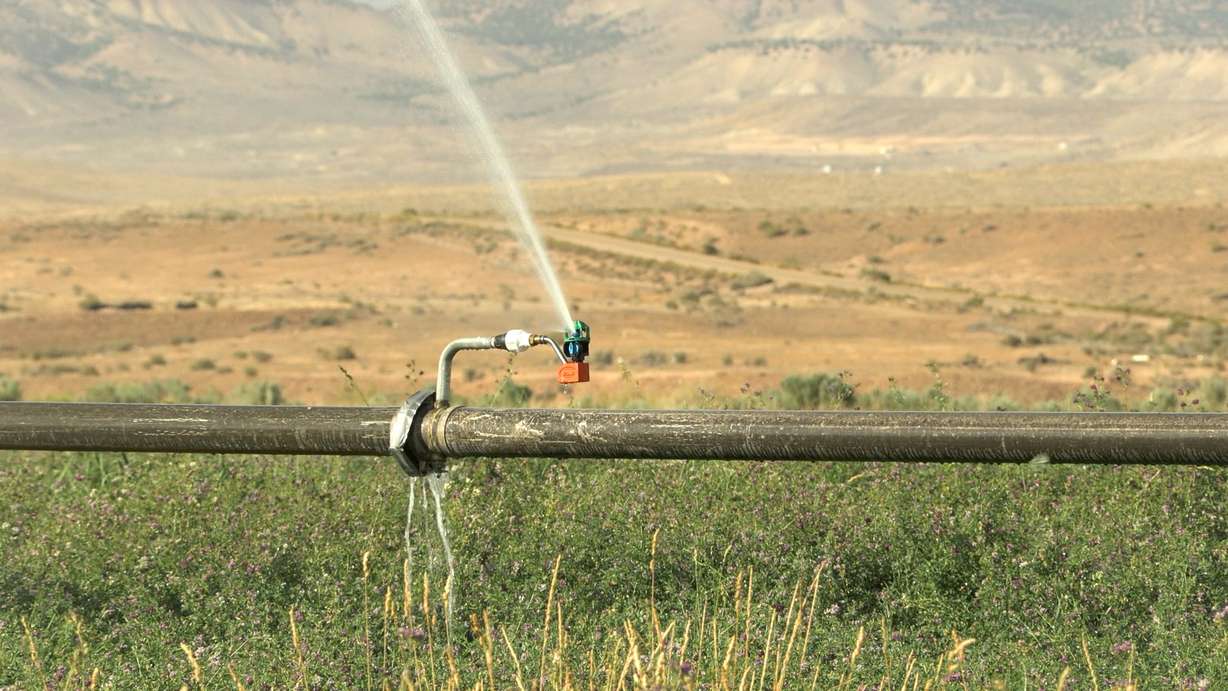
A sprinkler line at the Bar Lazy TL Ranch near Vernal. (Photo: Alex Cabrero, KSL)
Rather than simply telling farmers to use less water, researchers work directly with those who choose to participate in the voluntary program to understand how water is being used on individual farms.
“Are there leaks? Are there uniformity issues? Are there pressure issues? We do a full evaluation of it,” said Yost to a group of farmers who came to the Vernal ranch for a field day demonstration.
Farmers who decide to try the program receive soil moisture sensors, flow-monitoring equipment, soil and irrigation-water analysis and an evaluation of their irrigation systems.
They also develop a five-year irrigation management plan and share water-use data with USU researchers during their participation in the program.
The goal is to give farmers better information about how much water they are using, where it is going and whether changes in equipment or irrigation practices could make their operations more efficient.
“A lot of people are really nervous about tracking and sharing their water use information, understandably. So, part of this was just to help people be comfortable with that,” said Yost. “We do the research, we don’t tell farmers what to do.”
That distinction is important to researchers and farmers involved in the program because farm operations can vary widely. One technology that works well on one farm may not make economic or practical sense on another.
Controlling irrigation
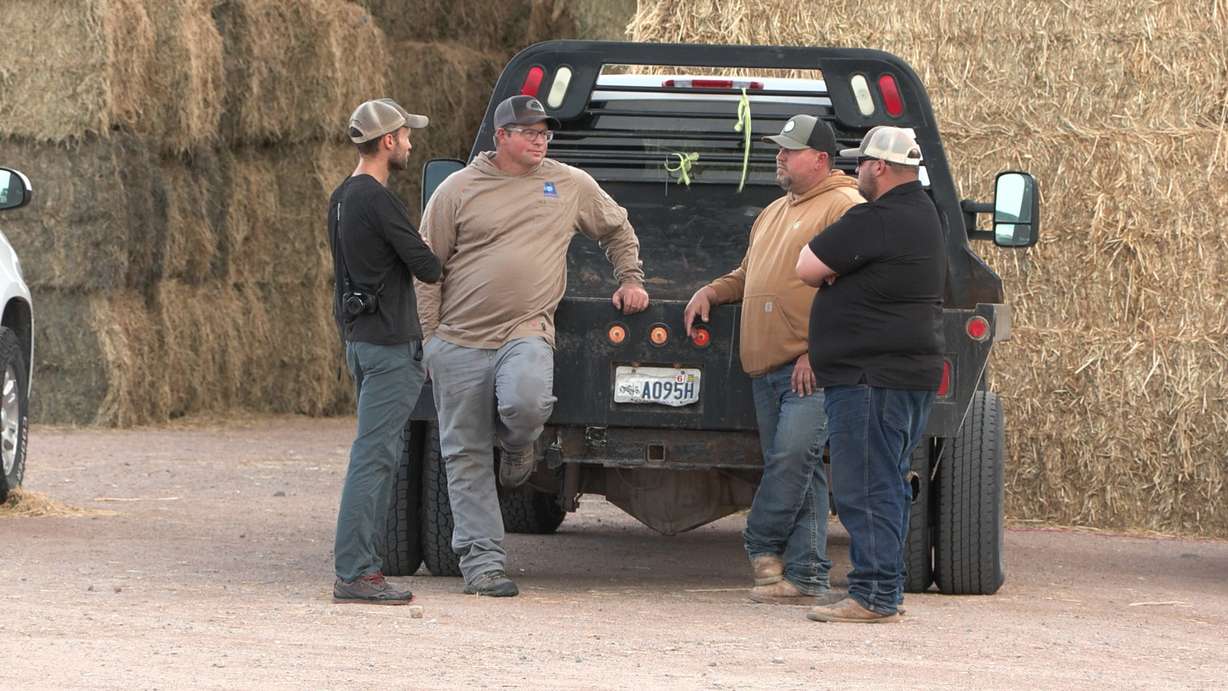
Farmers discussing the Ag-DRIP program in Vernal. (Photo: Alex Cabrero, KSL)
Kolby Hullinger, a crop farmer in Daggett County, said some of what researchers demonstrated could be useful in his operation, while other equipment might not be.
“I think most of it works,” said Hullinger. “The sprinklers, they offer a lot of good options.”
Researchers are also experimenting with automation.
During the demonstration, Barker held up a cellphone showing how a farmer could remotely control an irrigation system. Instead of physically returning to a field to shut off water, automation could allow the farmer to do it remotely and more precisely control how long the field is irrigated.
“It’s about helping farmers know how they could use these tools to manage irrigation,” said Barker.
The technology, though, does not change the key ingredient of farming in Utah, which is growing crops requires water.
Sharing the Colorado River
And with Upper and Lower Basin states along the Colorado River having a challenging time coming to terms with who gets what, everyone is being asked to be more efficient with water.
Ag-DRIP is designed in part to help farmers determine where those efficiencies may exist.
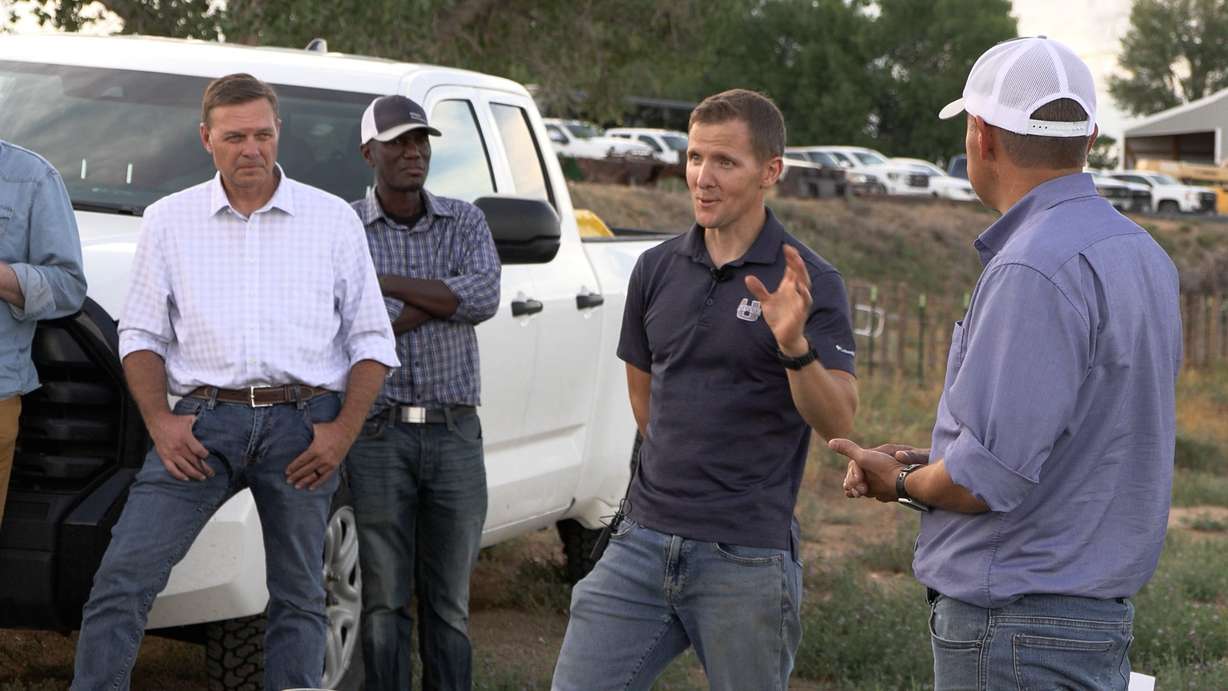
Matt Yost with Utah State University Extension discussing the Ag-DRIP program. (Photo: Alex Cabrero, KSL)
The program was launched in response to the severe drought from 2020 through 2022 that hit Utah agriculture particularly hard.
It is backed by a five-year, $5 million commitment and was designed to develop irrigation management plans on as many as 125 farms, with roughly 25 producers entering the program each year.
Participating farmers can receive thousands of dollars worth of monitoring equipment and technical assistance.
The program also provides incentives for trying lower-water crops and for continuing to report irrigation data.
Researchers said that data is important because the goal is not simply to install new equipment; it’s to determine which changes actually work.
“Farmers are really good at finding a way to be efficient if they have an incentive to do it,” said Boyd Kitchen, a farmer and retired USU Extension agent. “I think it’s a good thing to be researching if water improvements can be made.”
Every farmer participating in Ag-DRIP uses Colorado River Basin water. That’s one of the requirements of the program. That connects experiments on individual Utah farms with one of the most difficult water challenges facing the West.
The Colorado River supplies water to seven states: Utah, Colorado, Wyoming and New Mexico in the Upper Basin, and Arizona, California and Nevada in the Lower Basin, as well as Mexico.
It supports cities, agriculture, tribal communities, hydropower and ecosystems.
The rules governing much of the operation of Lake Powell and Lake Mead expire at the end of 2026.
For years, the seven Basin states have been negotiating over what should replace them and how future shortages should be handled when there is not enough water in the system to meet all demands.
So far, the states have not reached a consensus.
The disagreement involves fundamental questions about who should conserve water, when reductions should occur, and how those reductions should be shared between the Upper and Lower Basins.
Utah and the other Upper Basin states have argued that their water use already fluctuates with hydrology because much of their use depends on available snowpack and runoff.
Lower Basin states face their own challenges and have pursued significant conservation efforts as reservoir levels have declined.
With the states still unable to agree on a complete operating framework, the U.S. Department of the Interior and Bureau of Reclamation are continuing the federal process for determining how Lake Powell and Lake Mead will operate after the current rules expire.
The federal government has said a decision is needed before the beginning of the 2027 water year to provide certainty for communities and water users throughout the Basin.
That makes efforts to understand and improve water use increasingly important.
It’s the small things that matter
Ag-DRIP will not resolve the disagreement over the Colorado River, and a different sprinkler nozzle, soil moisture sensor, or remotely controlled wheel line will not solve the overall problem. But researchers said those smaller changes can still matter.
“I think we’ve got some good preliminary results,” said Barker.
A farmer who knows exactly how much moisture is in the soil may be able to make a better decision about when to irrigate; a flow meter can show how much water is actually being applied, a system evaluation can identify leaks or pressure problems, and automation can prevent water from running longer than necessary.
Multiply those decisions across farms and across years, and researchers hope the savings can add up.
“So far, it has been pretty positive,” said Barker. “I think that we’re in a place where, by the time we’re done with this project, which will sunset in about a year, we’ll have some really clear recommendations for producers running wheel lines that we just haven’t had.”