AP review: State supply stocks sparse and dated before virus
Apr 23, 2020, 3:01 PM | Updated: 4:26 pm
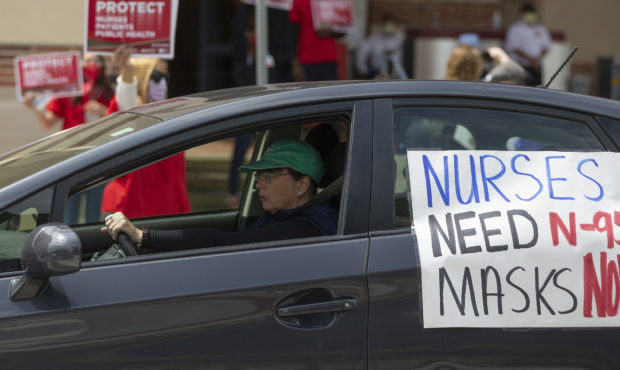
FILE - In this April 13, 2020, file photo, a car passes nurses protesting the lack of N95 respirators and other Personal Protective Equipment outside the UCLA Medical Center, Santa Monica amid the coronavirus pandemic in Santa Monica, Calif. An Associated Press review of more than 20 states found that before the coronavirus outbreak many had at least a modest supply of N95 masks, gowns, gloves and other medical equipment. But those were often well past their expiration dates — left over from the H1N1 influenza outbreak a decade ago. (AP Photo/Damian Dovarganes)
(AP Photo/Damian Dovarganes)
JEFFERSON CITY, Mo (AP) — Last autumn, when schools were in session, sports stadiums full and no one had even heard of the COVID-19 disease, the Missouri health department made an eerily foreshadowing request.
It asked the state for $300,000 to buy supplies and services in case of a large-scale disease outbreak. The goal was to fill a gap between local and federal sources.
Today, as states are spending billions of dollars buying supplies in the fight against the coronavirus, that October funding request appears woefully insufficient. Yet it highlights a stark fact: States were not stocked for a pandemic and have been scrambling to catch up.
AP reviewed 20 states
An Associated Press review of more than 20 states found that before the coronavirus outbreak many had at least a modest supply of N95 masks, gowns, gloves and other medical equipment. But those were often well past their expiration dates — left over from the H1N1 influenza outbreak a decade ago.
The shortage of supplies stemmed from a variety of factors — a decline in public health funding, a cost-saving dependence on having inventory on hand only for immediate use and a belief that the federal government could come to the rescue with its Strategic National Stockpile.
In hindsight, the federal stockpile proved insufficient for a nationwide viral outbreak, and a worldwide competition for scarce supplies revealed the folly of counting on rapid deliveries.
“You could see it in almost every state, in every locality, and the federal government level: depleting the resources, depleting the inventory, and hoping when you need them they will be available,” said Gerard Anderson, a health policy professor at Johns Hopkins University, which has tracked coronarivus cases and deaths across the world.
The coronavirus crisis spawned a political blame game over the shortage of protective gear for medical workers and the hunt for ventilators. Some governors harangued the federal government for leaving them in the lurch.
President Donald Trump faulted states, tweeting earlier this month: “The complainers should have been stocked up and ready long before this crisis hit.”
Before the World Health Organization issued a Jan. 9 advisory about the coronavirus emerging in China, Missouri had a supply of 663,920 N95 respirator masks, 253,800 surgical masks, 154,000 gloves, 17,424 face shields and 14,048 gowns. All were leftovers provided by the federal Centers for Disease Control after the H1N1 flu pandemic of 2009-2010, and well beyond their shelf life.
Other states also were relying on old supplies. Officials in California, Colorado, Connecticut, Illinois, Michigan, Nevada, New Hampshire, New Mexico, Ohio, Pennsylvania, Virginia, Vermont, Washington and West Virginia all told the AP that their stashes included at least some leftovers from the H1N1 flu.
Missouri, like some other states, had spent nothing to replenish the expired equipment. And even when asking for $300,000 last October, the state Department of Health and Senior Services stressed that it wasn’t trying to build a big reserve.
“Since outbreaks and the resources needed are not predictable, purchasing a large stock of supplies that could expire or become obsolete is not a responsible use of state funds,” the health agency said in a budget document submitted to Gov. Mike Parson and state lawmakers.
That funding request for the fiscal year that starts in July still was pending in the state House when Missouri’s first coronavirus case was confirmed last month. Since then, Missouri has ordered about $40 million of protective medical supplies for health care workers and emergency responders.
Missouri Health Director Randall Williams told the AP that it didn’t make sense to load up on supplies ahead of time without knowing what was needed. For example, he said, bug spray would have been more useful than face masks during the 2015-2016 epidemic of the Zika virus, which is spread by mosquitoes.
“If you spend money on prevention and whatever comes your way isn’t that, then you have less money for response” when an emergency occurs, Williams said.
Federal public health funding for states has been on a downward slide since new programs were launched after the 2001 terrorist attacks and anthrax scare. The Public Health Emergency Preparedness program provided $675 million last year — down 28% since 2003, according to the nonprofit Trust for America’s Health. The Hospital Preparedness Program provided $265 million last year — down by almost half during that same period.
Colorado used to have two medical stockpiles. But the state received minimal federal funding for storing supplies left over from the H1N1 pandemic and none to buy new supplies. The stockpile in Denver was dissolved last fall and its remnants transferred to one in Grand Junction. Those supplies had all been distributed by the beginning of March, as the coranavirus was spreading.
Ohio, like many states, began storing some supplies after the 2001 terrorist attacks. But its financial commitment has waned after each crisis was averted, said Deborah Arms, president of the Ohio Nurses Association, who led the state health department’s prevention division from the late 1990s to 2008.
“It’s always difficult for public health in these kinds of disasters to be able to advocate for continual funding … for something that might take 10 years to see a result,” she said.
Michigan, which has the third-highest coronavirus death toll among U.S. states, had 53,500 gloves left over from past epidemics, 5,120 N95 masks, 5,000 surgical masks and just 500 face shields among its pre-coronavirus supplies.
The state could not afford the cost of replacing expired items nor the warehouse fees for storing more, said Michigan Department of Health and Human Services spokeswoman Lynn Sutfin.
Michigan Gov. Gretchen Whitmer said the state had counted on the federal government to be prepared for a pandemic.
“No one could have said that they would come in and build a state stockpile. That’s never been the role and the assumption,” she told the AP. “Yet if I could turn back the clock, that’s precisely what we would have started doing.”
Contrary to Mr. Trump’s assertion that states bore the primary responsibility for stockpiling medical supplies, many states had depended on the federal government to store provisions in case of emergencies.
New Hampshire’s emergency operations plans call for maintaining a small reserve of supplies, but then “very much relying on the national stockpile for anything more than, say a week,” said state Health and Human Services Commissioner Lori Shibinette.
Virginia Secretary of Finance Aubrey Layne said he had viewed stockpiling supplies as a federal responsibility.
“Are we probably going to start stockpiling stuff now?” Layne asked. “The answer is yes.”
Even before the latest crisis, some experts had urged stocking up on supplies as a way to lessen the disruption to supply chains and avoid having to compete with other governments as a crisis is unfolding. A June 2009 report published in the CDC’s journal Emerging Infectious Diseases recommended a “stratified purchase plan” — buying essential items periodically as money became available.
“Supplies need to be ordered far in advance of a pandemic to avoid major problems with back orders and supply shortfalls,” the report concluded.
Instead, public health offices, hospitals and medical clinics have largely been ordering supplies as they are needed. But just-in-time buying doesn’t work when supply chains collapse and every state and country competes in world markets for scarce equipment during a pandemic.
“We’ve short-shrifted our public health structure, because we don’t need it until it happens. But then it’s too late to build it when there’s a pandemic,” said California state Sen. Richard Pan, a pediatrician.
Sean Dunn, an Ohio lobbyist who has represented hospitals, product distributors and a health care services company, said government and health officials need to rethink their approach.
“The notion of having to keep stores of anything, until a couple of weeks ago, was an old-fashioned notion,” Dunn said. “This is going to change our mindset.”
___
Dil reported from Sacramento, California.
___
Associated Press writers Julie Carr Smyth in Columbus, Ohio; Alan Suderman in Richmond, Virginia; James Anderson in Denver; David Eggert in Lansing, Michigan; and Holly Ramer in Concord, New Hampshire, contributed.