How to watch the Artemis I mission lift off to the moon
Aug 28, 2022, 1:00 PM
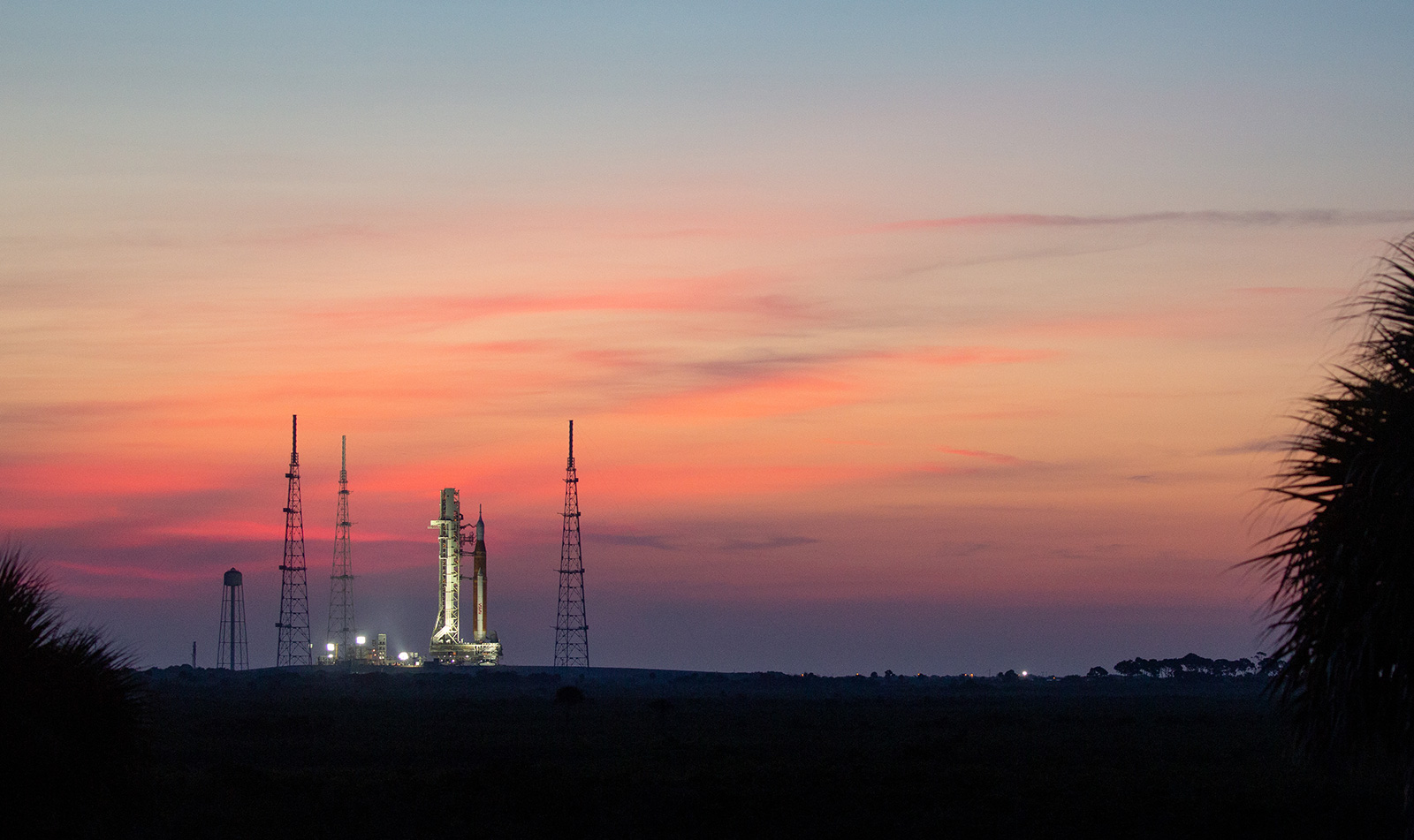
NASA’s Space Launch System (SLS) rocket with the Orion spacecraft aboard is seen at sunrise atop the mobile launcher as it arrives at Launch Pad 39B, Wednesday, Aug. 17, 2022, at NASA’s Kennedy Space Center in Florida. NASA’s Artemis I flight test is the first integrated test of the agency’s deep space exploration systems: the Orion spacecraft, SLS rocket, and supporting ground systems. Launch of the uncrewed flight test is targeted for no earlier than Aug. 29. Photo Credit: (NASA/Joel Kowsky)
(NASA/Joel Kowsky)
(CNN) — For the first time in 50 years, a spacecraft is preparing to launch on a journey to the moon.
The uncrewed Artemis I mission, including the Space Launch System Rocket and Orion spacecraft, is targeting liftoff on August 29 between 8:33 a.m. ET and 10:33 a.m. ET from NASA’s Kennedy Space Center in Florida.
Although there is no human crew aboard the mission, it’s the first step of the Artemis program, which aims to return humans to the moon and eventually land them on Mars
The weather is looking good for launch. For the beginning of the Monday launch period, the chances of favorable weather have gone up to 80%, according to the 6:45am ET Sunday US Space Force forecast. However, closer to the end of the launch period the chances decrease to 60% as the chance for scattered showers and storms increases.
The welcome news was announced Sunday, one day after the mega moon rocket experienced multiple lightning strikes while sitting at the launchpad at Kennedy Space Center in Florida on Saturday.
Teams worked overnight to assess the potential impacts of the five events recorded by the lightning protection system towers at Launchpad 39B during a thunderstorm Saturday afternoon.
After determining that the strikes were likely low magnitude, the team decided that no significant retests were needed and “everything looks really good,” said Jeff Spaulding, Artemis I senior NASA test director.
If the rocket is unable to launch Monday, the next possible launch would be Friday, September 2 at 12:48pm ET.
The Orion spacecraft will enter a distant retrograde orbit of the moon and travel 40,000 miles beyond it, going further than any spacecraft intended to carry humans. Crews will ride aboard Artemis II on a similar trajectory in 2024, and the first woman and the next man to land on the moon are slated to arrive at the lunar south pole in late 2025 on the Artemis III mission.
The agency will share live views and coverage in English and Spanish before, during and after the Artemis I launch on its website and on NASA TV. The broadcast will begin at 12 a.m. ET as supercold propellant is loaded into the SLS rocket.
Appearances by celebrities like Jack Black, Chris Evans and Keke Palmer and performances of “The Star-Spangled Banner” by Josh Groban and Herbie Hancock and “America the Beautiful” by The Philadelphia Orchestra and cellist Yo-Yo Ma are also part of the program.
Once the launch has occurred, NASA will conduct a post-launch briefing, and later in the day, the agency will share the first Earth views from cameras aboard the Orion spacecraft.
Orion’s journey will last 42 days as it travels to the moon, loops around it and returns to Earth — traveling a total of 1.3 million miles (2.1 million kilometers). The capsule will splash down in the Pacific Ocean off the coast of San Diego on October 10.
Cameras inside and outside of Orion will share images and video throughout the mission, including live views from the Callisto experiment, which will capture a stream of a mannequin called Commander Moonikin Campos sitting in the commander’s seat. If you have an Amazon Alexa-enabled device, you can ask it about the mission’s location each day.
Here’s everything you can expect before, during and after the launch.
Counting down to launch
The official launch countdown wbegan on August 27 at 10:23 a.m. ET.
The call to stations occurred Saturday morning at Kennedy Space Center, as well as for teams offering support from various centers across the country. This is when all of the teams associated with the mission arrived at their consoles and reported that they were ready, kicking off the two-day countdown.
Over the weekend, engineers are powering up the Orion spacecraft, the interim cryogenic propulsion stage (the upper part of the rocket) and core stage, charge batteries and conduct a final preparation for the engines.
Late Sunday night into early Monday morning, the launch team will conduct a briefing to discuss weather conditions and decide if they are “go” or “no go” to begin fueling the rocket.
If everything looks good, the team will begin fueling the rocket’s core stage eight hours before launch. Five hours before, the upper stage will begin fueling. Afterward, the team will top off and replenish any of the liquid hydrogen and liquid oxygen that dissipates during the fueling process.
About 50 minutes before launch, the final NASA test director briefing will occur. A planned 30-minute countdown hold will start about 40 minutes before launch.
The launch director will poll the team to make sure that every station is “go” 15 minutes ahead of liftoff.
At 10 minutes and counting, things kick into high gear as the spacecraft and rocket go through the final steps. Much of the action takes place in the final minute, as the ground launch sequencer sends the command for the rocket flight computer’s automated launching sequencer to take over about 30 seconds prior to launch.
In the last few seconds, hydrogen will burn off, the four RS-25 engines will start, resulting in booster ignition and liftoff at T minus zero.
Journey to the moon
After liftoff, the solid rocket boosters will separate from the spacecraft about two minutes into the flight and splash down in the Atlantic Ocean, with other components also jettisoning shortly after. The core stage of the rocket will separate about eight minutes later and fall toward the Pacific Ocean, allowing for Orion’s solar array wings to deploy.
The perigree raise maneuver will occur about 12 minutes after launch, when the ICPS experiences a burn to raise Orion’s altitude so it doesn’t reenter the Earth’s atmosphere. Shortly after that is the trans-lunar Injection burn, when the ICPS boosts Orion’s speed from 17,500 miles per hour (28,163 kilometers per hour) to 22,600 miles per hour (36,371 kilometers per hour) to escape the pull of Earth’s gravity and set off for the moon.
After this burn, the ICPS will separate from Orion.
Around 4:30 p.m., Orion will make its first outbound trajectory correction burn using the European Service Module, which provides the spacecraft with power, propulsion and thermal control. This maneuver will put Orion on a path to the moon.
The next few days after launch, Orion will venture out to the moon, coming within 60 miles (96 kilometers) during its closest approach of the lunar surface on day six of the journey — or September 3 if the launch occurs as planned on August 29. The service module will place Orion in a distant retrograde orbit around the moon on day 10, or September 7.
Orion will surpass the distance record of 248,654 miles (400,169 kilometers) — set by Apollo 13 in 1970 — on September 8 when it loops around the moon. The spacecraft will achieve its maximum distance from Earth of 280,000 miles (450,616 kilometers) on September 23 when it ventures 40,000 miles (64,373 kilometers) beyond the moon.
READ MORE: Artemis I by the numbers
This is 30,000 miles (48,280 kilometers) farther than Apollo 13’s record.
Orion will make its second-closest approach of the lunar surface, coming within 500 miles (804 kilometers), on October 3. The service module will experience a burn that enables the moon’s gravity to slingshot Orion back on its way to Earth.
Just before reentering Earth’s atmosphere, the service module will separate from Orion. The spacecraft will hit the top of Earth’s atmosphere moving at about 25,000 miles per hour (40,233 kilometers per hour), and its heat shield will experience temperatures of nearly 5,000 degrees Fahrenheit (2,760 degrees Celsius).
The atmosphere will slow Orion down to about 300 miles per hour (482 kilometers per hour), and a series of parachutes will slow it down to less than 20 miles per hour (32 kilometers per hour) before it splashes down in the Pacific Ocean at 11:53 a.m.
Splashdown will stream live from NASA’s website, collecting views from the 17 cameras aboard the recovery ship and helicopters that will be waiting for Orion’s return.
The landing and recovery team will collect the Orion capsule, and the data collected by the spacecraft will determine what lessons have been learned before humans return to the moon.