NASA is heading back to the Moon — and Canada’s coming, too
Aug 28, 2022, 8:52 AM | Updated: Aug 31, 2022, 10:00 am
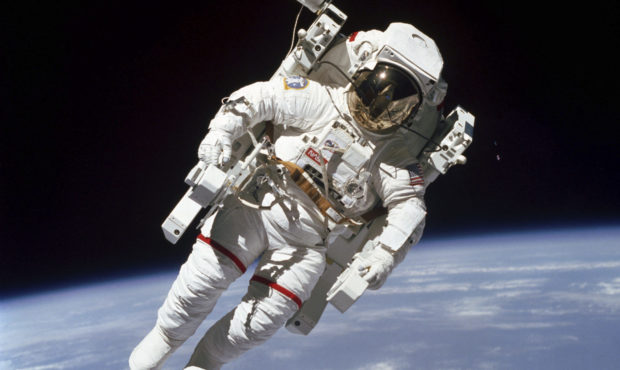
In this Feb. 7, 1984 photo made available by NASA, astronaut Bruce McCandless II, performs a spacewalk a few meters away from the cabin of the Earth-orbiting space shuttle Challenger, using a nitrogen-propelled Manned Maneuvering Unit. On Wednesday, April 1, 2020, NASA said that more than 12,000 Americans from all 50 states, the District of Columbia and four U.S. territories applied to be part of the space agency's next astronaut class. The month-long application period ended Tuesday. (NASA via AP)
(NASA via AP)
(CTV Network) — On Monday, a rocket will be blasting off to orbit around the Moon as the first step in humanity’s grand return to the lunar surface. But it’s not just an exciting moment for NASA. This time, the journey back to the Moon is an international collaboration, one that will see Canadian technology and Canadian astronauts making a clear mark on lunar history. Canada is heading to the Moon — and Monday is just the start. In under a decade, scientists hope to have developed a space station called the Lunar Gateway to serve as a stepping stone for travel to Mars and beyond, and Canada is developing a rover to explore the Moon’s surface. “The idea is to set up a base camp on the surface of the moon, with an orbiting space station that will orbit the Moon,” Orbax Thomas, a physics researchers with the University of Guelph, told CTV National News. “That will allow scientists to do research and learn things from the Moon in the hope that as we continue to expand out into the nether regions of the universe, and move towards putting up colonies in places like Mars, we have an opportunity to learn how to do that while we’re relatively close to home.”
Tune in to Dave & Dujanovik as they discuss the cost of the mission.
To view this video please enable JavaScript, and consider upgrading to a web browser that supports HTML5 video
At the Kennedy Space Centre in Florida, U.S., the mission, given the name Artemis I, will launch during a two-hour window on Aug 29, the first test of a series of space exploration systems that NASA and its partners have been working on for years. Utilizing the most powerful rocket that humans have ever built, the unmanned Orion spacecraft will be sent into space in order to orbit the Moon to collect data and test the capabilities of the spacecraft. Only mannequins will be inside the Orion, but the spacecraft is designed to support humans, making this first test a crucial one for future missions. Paul Delaney, professor of physics and astronomy at York University, explained to CTV News Channel on Saturday that these mannequins are “bristling with radiation detectors, making sure that the exposure to deep-space radiation that the astronauts are going to experience is within the expected limits.” After the more-than-300-foot spacecraft completes its 42 day mission in space, it will return to Earth, splashing down in the ocean to test how future astronauts will get home. If Artemis I is successful, it’ll soon be time for Artemis II, the first crewed flight back to the Moon — which is when Canada’s role in lunar exploration starts to become a crucial one.
Artemis II, currently projected for 2024, will see a spacecraft carry four human beings into orbit around the Moon for the first time since 1972. One of those astronauts will be from the Canadian Space Agency (CSA), and will be the first non-American astronaut to fly to the Moon. It will also make Canada the second nation with an astronaut to travel all the way around the Moon.
A Canadian astronaut is also guaranteed to be on another flight in the future to the Gateway, the eventual space station set to orbit the Moon. The Gateway will also be home to one of Canada’s biggest contributions to this stage of space exploration: the latest iteration of the iconic Canadarm. In 1981, the first Canadarm made its space debut. These giant robotic arms were attached to the outsides of space shuttles and controlled by astronauts in the shuttle, used to move objects around in space that the astronauts otherwise could not. The International Space Station (ISS) orbiting Earth currently hosts the Canadarm 2, which is permanently mounted on the space station and can be controlled from Earth or by astronauts in the station. The Canadarm 3 will actually be smaller and lighter than previous versions at 8.5 metres in length, but it is planned to boast artificial intelligence, six 4k cameras and other cutting-edge technology.
“It’s the furthest into space that we’ve ever had a Canadarm,” Orbax said, noting that while the ISS is around 400 kilometres straight above us, the Gateway will be 400,000 kilometres away from Earth. “And it will be not only moving objects, helping the Orion shuttle to dock onto the Gateway space station itself, but it’ll actually be used to build the Gateway itself.” The Canadarm 3’s ability to perform some tasks without guidance will be hugely important to the Gateway’s functioning once it has been built. The space station won’t always have a crew, and there will be regular intervals in which the Gateway will be completely out of communication with crews on Earth, as its orbit takes it to the opposite side of the Moon.
According to the CSA, the Canadarm 3 will even be able to perform science experiments on its own while hurtling around the Moon. The Canadarm has always been one of Canada’s most well-known contributions to space technology; it was Canada’s agreement to contribute the Canadarm 3 for the Gateway that secured a spot for a Canadian astronaut on the Artemis II. Once the Gateway is built, scientists will be able to shuttle back and forth between the surface of the Moon and the Gateway space station orbiting around the Moon.
Soon, we’ll be leaving new footprints on the lunar surface. As early as 2025, Artemis III may be carrying a crew down to the Moon itself. This mission aims to land the first woman on the Moon and the first person of colour. “NASA is going to make history,” Randy Lycans, general manager of NASA’s Enterprise Solutions, said in a press conference. The return to the Moon’s surface will be followed by a first for Canada: a lunar rover. In 2021, it was announced that a Canadian rover would be landing on the Moon within the next five years as part of the lunar missions planned with NASA.
The CSA has already selected two Canadian companies, MDA and Canadensys, to design rover concepts. The aim is to create a rover capable of surviving the lunar night during a planned two-week mission. One night on the Moon lasts for 14 Earth days, and conditions are extremely cold, as well as completely dark, posing challenges for rovers. The rover is hoping to carry out a mission at the Moon’s south pole to test science instruments helping regulate functions such as mobility, navigations and thermal management, information that could help us in future trips to Mars.
The rollout of missions that starts on Monday with Artemis I is led by NASA, but involves contributions from not only CSA, but the European Space Agency and the Japan Aerospace Exploration Agency. Although this next step in space exploration is beginning with a return to the Moon, the goal is to set us up for probing even deeper into space, with a lunar outpost as a reference for future research and future space travel. “Space, unlike anything else, unifies us as a people,” Orbax said. “Whether you’re an academic, or whether you’re a scientist, or whether you’re a citizen, everybody has looked up and had that wonder of ‘what’s going on up there in the universe above us?’” With files from Cristina Tenaglia