Men, morale, munitions: Russia’s Ukraine war faces long slog
Jun 20, 2022, 8:57 AM | Updated: 9:06 am
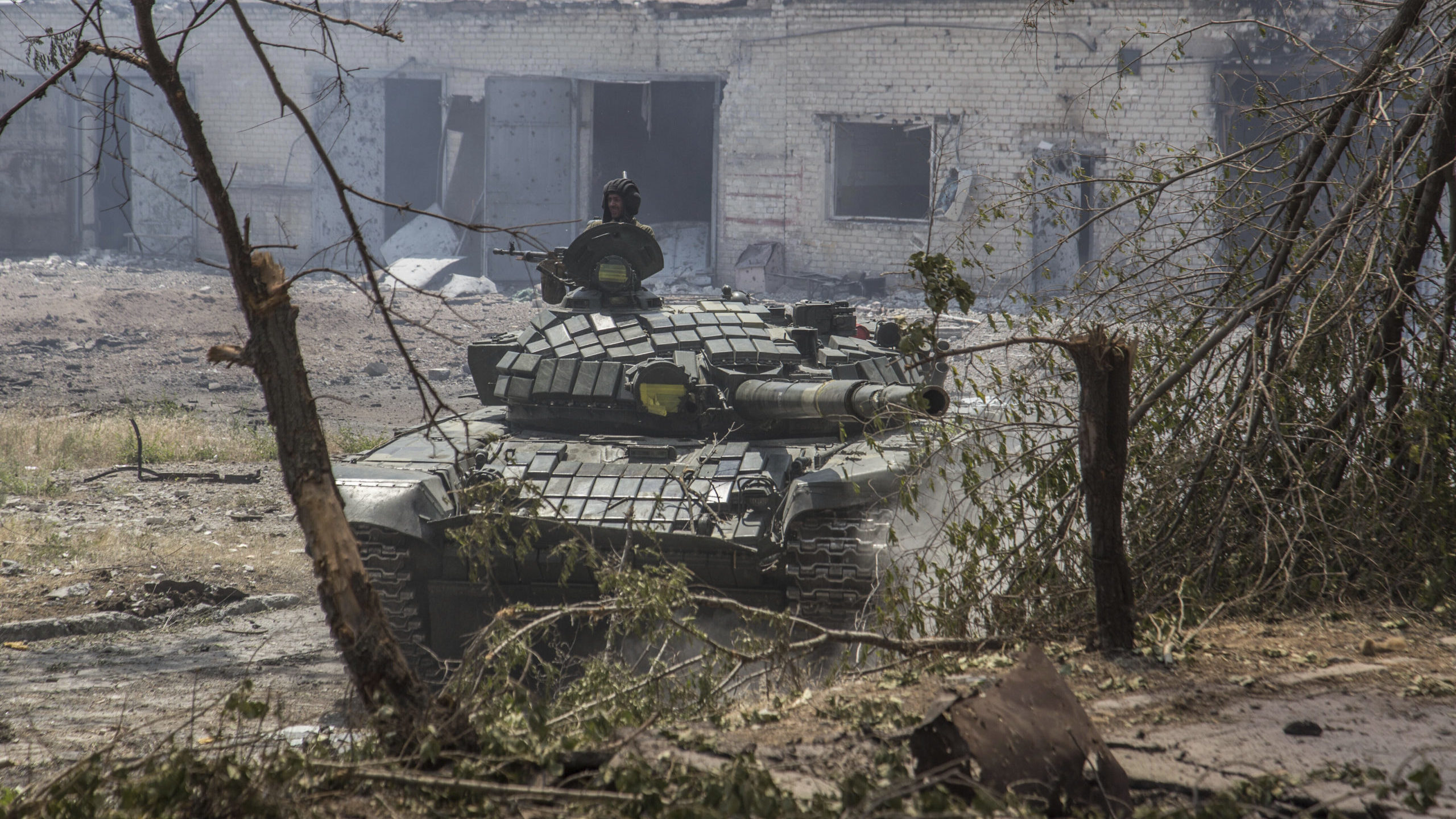
FILE - A Ukrainian tank is in position during heavy fighting on the front line in Severodonetsk, the Luhansk region, Ukraine, Wednesday, June 8, 2022. Photo: AP- Oleksandr Ratushniak
BAKHMUT, Ukraine (AP) — From a hideout in a bombed-out house in eastern Ukraine, army commander Mykhailo Strebizh twirls a mortar shell the size of a bowling pin, calling it “aid we got from Europe and America.”
He then turns to a makeshift blackboard — a door with words written on it in chalk — showing weapon inventories. One line says “NATO” in Cyrillic letters, then a number: 11.
These days, Ukraine’s beleaguered but unbowed forces are doing a lot of counting about the help they’re getting from abroad.
As Russia’s initially botched and broad offensive turns its focus to the eastern Donbas region, the war has entered a new and seemingly more enduring phase. While Russia has kept quiet about its war casualties, Ukrainian authorities say up to 200 of their soldiers are dying each day. Experts say both sides are taking heavy losses.
The United States last week upped the ante with its largest pledge of aid for Ukrainian forces yet — an additional $1 billion in military assistance aimed to help repel or reverse Russian advances.
But experts note that such aid deliveries haven’t kept pace with needs, raising questions about how sustainable the war effort will be — and how defense industries on both sides can continue to feed it.
“We’re moving from peacetime to wartime,” said Francois Heisbourg, a senior adviser at the Paris-based Foundation for Strategic Research think tank.
“Peacetime means low production rates, and ramping up the production rate means that you have to first build industrial facilities … This is a defense-industrial challenge which is of a very great magnitude.”
That, in part, explains why Western deliveries of much-ballyhooed support for Ukraine have often fallen short and are slow in coming.
The Kiel Institute for the World Economy in Germany last week issued a “Ukraine Support Tracker” that showed the U.S. has delivered about half of its pledged commitments in military support for Ukraine, and Germany about one-third. Poland and Britain had both delivered on much of what they had promised, the report showed.
Earlier this month, Ukraine’s ambassador in Madrid, Serhii Phoreltsev, thanked Spain — which trumpeted shipment of 200 tons of military aid in April — but said the ammunition that was included was only enough for “about two hours of combat.”
Ukrainian filmmaker-turned-fighter Volodymyr Demchenko, tweeted a video of himself expressing gratitude about U.S. firearms: “There is American guns they send to us. It’s nice guns, and 120 bullets to each,” he said, before lamenting: “It’s like 15 minutes of a fight.”
Over the weekend, NATO Secretary-General Jens Stoltenberg warned the war could last years, and British Prime Minister Boris Johnson pledged more training of Ukrainian troops abroad, the latest sign that friends of Ukraine’s government are digging in for the long haul even as he warned of growing “Ukraine fatigue” in the minds of the public abroad.
Part of the issue is that Ukrainian forces, whose country was once a stalwart member of the Soviet Union, are more familiar with Soviet-era weaponry than NATO equipment. Take artillery: The Western standard is 155mm artillery, while the Russian and Ukrainian forces have traditionally used 152mm stocks.
An untold number of Ukrainians have traveled abroad to get training on the Western-standard kit.
Of the $1 billion pledge from the U.S., only slightly more than one-third of that will be rapid, off-the-shelf deliveries by the Pentagon, and the rest will be available over a longer term. The pledge, which includes 18 howitzers and 36,000 rounds of ammunition for them, addresses Ukraine’s plea for more longer-range weaponry.
That’s far short of what the Ukrainians want — 1,000 155-mm caliber howitzers, 300 multiple-launch rocket systems, 500 tanks, 2,000 armored vehicles and 1,000 drones — as President Volodymyr Zelenskyy’s adviser Mikhail Podolyak tweeted last week, before the latest big Western pledges.
“What the Ukrainians have got to do is conduct what military people tend to call a counter-battery operation” to respond to Russian artillery fire, said Ben Barry, a former director of the British Army Staff who is senior fellow for land warfare at the International Institute for Strategic Studies.
“To do this, you need accurate weapons with a high rate of fire and a range that allows them to keep out of the way of the other side’s artillery.”
“The Ukrainians are saying they don’t have enough long-range rockets to adequately suppress Russian artillery,” he said. “I think they’re probably right.”
Analysts say the Russian military’s big advantage has been its stockpiles of artillery and an expertise in using it, which dates back centuries. Their concentration on the east, and not broader swaths of Ukraine, has allowed them to shorten supply lines that were too long earlier in this war.
Time, on the other hand, is on Ukraine’s side, the experts say: Ukrainian fighters are both motivated and mobilized — all men in the country of 40 million have been called to fight, whereas Russia has so far avoided a call-up of conscripts, which could vastly tilt the war in Russia’s favor, but may not be popular with all Russians.
Experts have noted declining morale on both sides as the standoff, notably in and around the city of Sievierodonetsk in recent weeks, has dented fighting spirit and prompted front-line fighters to question and defy orders from above.
Russia has been targeting stockpiles and supply lines, and hitting them, Russian military chiefs say. Ukrainian authorities have either denied such claims, or said nothing about them: Neither side wants to let on to the other too much about the damage and deaths they are sustaining.
As to how long such fighting could least, analyst Heisbourg admits “that’s a hard one” but sees parallels between Ukraine today and France when Germany invaded in World War I — a population of about 40 million in Ukraine today and France before that war; the invaders neared the capital early on before being pushed back a bit; France had ammunition shortages, just as Ukraine does with artillery today.
A years-long war of attrition is “quite possible,” he said.
___
Jamey Keaten reported from Geneva.