Utah clergy examine the death penalty through a lens of faith
Oct 5, 2024, 12:00 PM | Updated: 5:02 pm

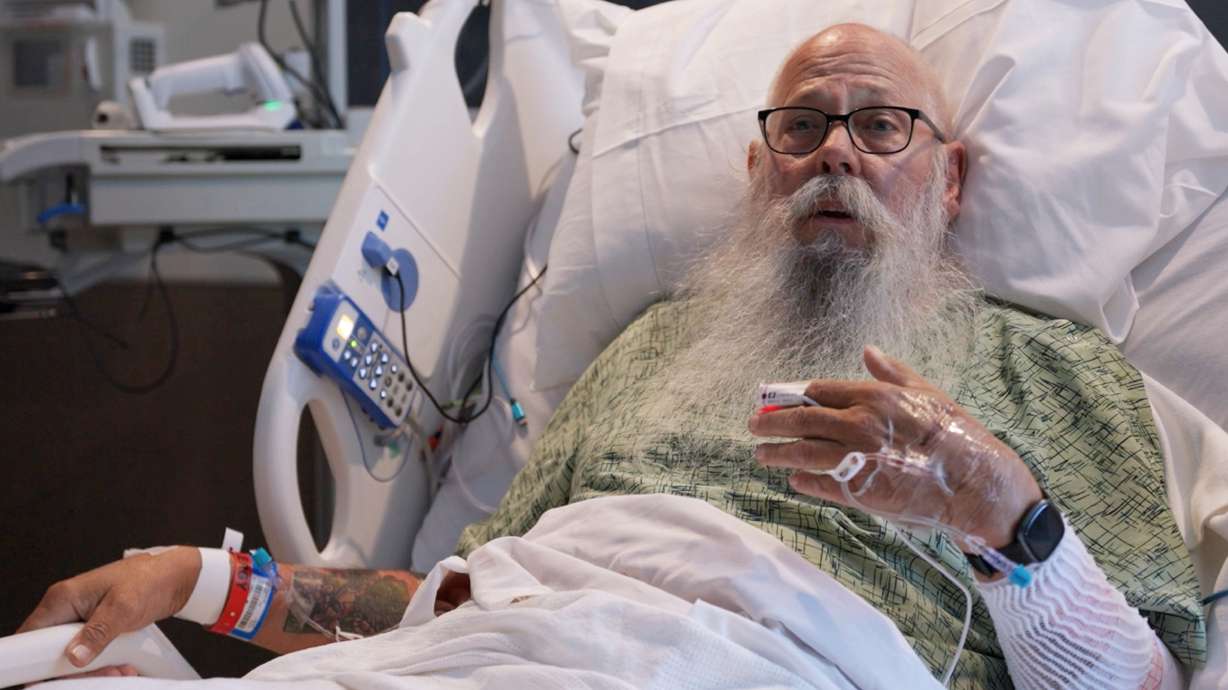
The room at the Utah State Prison where Taberon Honie was executed by lethal injection in August. He was the eighth person to face the death penalty in Utah since 1977, when capital punishment was reinstated by the U.S. Supreme Court. (Utah Department of Corrections)
(Utah Department of Corrections)
SALT LAKE CITY — The execution of Taberon Honie reignited ethical, legal and moral debates around the death penalty in Utah.
Protesters set up about a mile outside of the Utah State Correctional Facility and held signs decrying capital punishment and urging the state to stop the execution. In the days and weeks ahead of Honie’s death, his attorneys argued that the process to use a specific lethal injection drug needed more transparency and that the state should have considered more mitigating circumstances before reaffirming his sentence.
In a new conversation airing on KSL NewsRadio between General Conference sessions, KSL at Night Hosts Greg Skordas and Adam Gardiner look at capital punishment through a lens of faith, with the help of local clergy and religious scholars.
The history of the death penalty in Utah
On Aug. 8, 2024, Taberon Dave Honie became the eighth person to face the death penalty by lethal injection in Utah since capital punishment was reinstated in 1977. He was also the first person executed in Utah’s new state correctional facility.
Honie, 48, received the death sentence in 1999 for the 1998 murder of his ex-girlfriend’s mother, Claudia Benn.
Utah played a significant role in the history of the death penalty, according to Skordas. As a practicing defense attorney and a former prosecutor, Skordas worked on capital cases from both sides.
“Utah, like every state, had a moratorium. The federal government, in a case called Furman v. Georgia, declared in the early 70s that the death penalty was off the table,” Skordas said. “And Utah was the first state to reinstate the death penalty [after the moratorium ended].”
That happened in 1977 when Utah executed Gary Gilmore. He was the first man to face capital punishment after the nationwide moratorium ended.
Related: A look at Utah’s most infamous death row inmates
“It was a time when Utah still used the firing squad. And at the time, we were the only state to do that,” said Skordas. “Right now in Utah, there are six men on Death Row. And since 1972, only eight men have been executed [here].”
Skordas noted that capital crimes in Utah require a higher standard of proof in order to convict and sentence.
“A lot of people think that murder is always a death penalty situation, and it’s not. We used to have in Utah first-degree and second-degree murder. We now call it aggravated murder and murder,” Skordas said. “So a murder in Utah — and most states follow the same rule — is a knowing and intentional cause of the death of another person, period. That’s punishable by up to life in prison. But, in order to make a murder into an aggravated murder, there has to be enumerated aggravating factors.”
In Honie’s case, the aggravating factors included the rape of his murder victim and sexual assault of one of her granddaughters. During his commutation hearing, Honie said he could not remember the crime. His mother and daughter pleaded with the Utah Board of Pardons and Parole to spare his life. Relatives of his victim urged the state to carry out the execution.
Where the debate stands in Utah politics
Measures that would abolish the death penalty in Utah get introduced every few years.
In 2022, Rabbi Avremi Zippel of Chabad Lubavitch of Utah spoke to legislators about one such proposal. If allowed to do so again, he said he would encourage them to seek multiple perspectives.
“I would hope that the legislators involved in this conversation are involving every imaginable voice in that conversation,” Zippel said. “[Arriving] at an opinion that they can go back to their constituents and say, ‘Look, this is in the best interest of the citizens of Utah, period,’ would involve conversations from all groups. From religious leaders, from victims’ rights groups, from the defense side of things, from the prosecutor side of things.”
Zippel’s testimony two years ago came from a victim’s perspective, about which he has written extensively.
Related: What resources are available to victims’ families in death penalty cases?
“Some victims’ families say, ‘I don’t want to do this every two years. I don’t want to be involved in hearing after hearing and appeal after appeal,” Zippel said. “Just lock the guy up and I don’t want to hear from him ever again.’ And I think that an informed legislature is taking all of those opinions into account.”
But from a faith perspective, he said his testimony would look different.
I think that the best thing that I could do as a religious leader is look those legislators in the eye and say, ‘One question for you. You’re a person of faith, a man or a woman of faith. When you make this decision, when you support either keeping it or getting rid of it, if you had to sit down across from the Almighty and justify that decision, do you feel you can do that?’ And that’s not a condescending question and that’s not a rhetorical question. It’s an honest question. And if you feel you can do that in good faith, then you’re elected by your constituents, and you’re going to go about leading your political life in a way that’s not at odds with your personal life, with your religious life, then all the power to you. And if you do feel at some point like that decision is motivated from something else that you can’t square away with God one-on-one, in your heart of hearts, then perhaps reconsider that.” – Zippel
“I bet we’ll see this revisited.”
Gardiner, a Republican and former Utah state representative, understands the complicated process behind changing a law.
“[The Utah Legislature seems] to revisit [the death penalty] every four or five years up on Capitol Hill,” Gardiner said. “[Two years ago] was the most support I had ever seen in my time up on Capitol Hill for repealing the death penalty.”
That attempt failed to get out of committee by only one vote, but not for lack of trying.
“If you remember the book ‘Just Mercy’ by Bryan Stevenson, he came to Utah’s Capitol Hill,” Gardiner said. “There was a big reception in the Capitol Rotunda. It was very well attended. Lots of citizens came and he was in the back rooms of the Senate and the House, meeting individually with legislators, explaining kind of his travels. And that was the closest we ever came [to a repeal] and it didn’t get past a committee.”
Related: Letters from death row: The writing campaign of Doug Lovell
In the 1990s, Utah law changed to include a third option for murder sentences: life without the possibility of parole.
Prior to 1992, convicted murderers could either receive a death sentence or serve life with the possibility of parole. Gardiner sees the updated law as a way to balance the need for justice with mercy.
Would Utah ever eradicate the death penalty?
“A majority of legislative leadership in both houses, the Senate and the House, need to be on board with repealing the death penalty,” Gardiner said. “If they’re on board, then it goes away. And right now that’s just not the case. They’re still a very conservative Republican legislature. And so I think they have a long way to go, but I bet we’ll see this revisited in another three or four years.”
How do different religions view the death penalty?
The Very Reverend Martin Diaz serves as Rector of The Cathedral of the Madeleine with the Catholic Diocese of Salt Lake City. He said Pope Francis recently updated the catechism of the Catholic Church, which guides Catholics worldwide, not just in Utah.
“The catechism teaches that the death penalty is inadmissible,” Diaz said. “You cannot put it forward as an option in a legal case. We’re not talking about the laws of any country, but from a moral point of view, it is inadmissible, so you would not be able to say, as a Catholic, be in favor of the death penalty.”
In other words, even if called to serve on a Utah jury in a death penalty case, a Catholic could not vote for execution.
“You would have to say, ‘God’s law says I cannot impose the death penalty. Therefore I cannot sit on this jury’,” Diaz said.
Evolving viewpoints over time
Patrick Q. Mason, a professor of religious studies and history at Utah State University, serves as the Leonard J. Arrington Chair of Mormon History and Culture as well as director of the USU Religious Studies program.
Mason said The Church of Jesus Christ of Latter-day Saints has no official position on capital punishment.
“The church neither favors nor opposes the death penalty, and just leaves it up to the political realm for whatever state or country to pass laws,” Mason said.
I think part of the question we have to ask ourselves as citizens, if we are religious people, is, ‘Do we want the state committing that kind of violence against somebody who was no longer a threat to society in any way — do we want that?’ – Mason
Mason said in the early days of the church, Latter-day Saint leaders supported the death penalty.
“It was part of the criminal statute of the territory of Utah, which was dominated by Latter-day Saint leaders who were also church leaders and political leaders, and then that became the law of the state of Utah as well,” Mason said. “And you have statements from senior church leaders supporting the death penalty well into the 20th century… that has changed in recent decades. So it’s gone from a position of fairly strong support for the death penalty to now a position of official neutrality.”
Essentially, modern Latter-day Saint leaders leave decisions and opinions about capital punishment up to individual citizens, legislators and state government.
Read more: Utah debates whether to keep or abolish death penalty
Diaz said the position of the Catholic Church also evolved through history.
“I want to say the point of the death penalty [for] a person who is a danger to society is to protect society,” Diaz said. “In days gone past, when the penal system could not effectively incarcerate someone who would remain a danger to society, the only option would be to take that person’s life. But today, our penal system and our incarceration system is so effective that that person is not a danger to society at all, because they’re incarcerated.”
Latter-day Saints and Catholics alike believe everyone has a right to life even before birth.
“No other person can take away that right, because it’s a right that comes from God,” Diaz said.
Diaz said some Catholics actively oppose the death penalty and openly protest executions as well as push for changing the law. In contrast, Latter-day Saints find themselves both for and against capital punishment and even undecided.
“When these debates come up, for instance in the state of Utah, you’ve got Latter-day Saints who are on both sides of the issue, and they might even be using religious arguments,” Mason said.
The role of faith leaders in Utah politics
Representing the Jewish faith in Utah, Zippel pointed to Jewish law as laid out by Moses, then later carried on and expanded in the Talmud and oral laws passed down for generations.
“These are the texts that have guided our people for thousands of years, and these alone are the determining texts of what constitutes Jewish law, Jewish faith, Jewish philosophy, etc.,” Zippel said. “The five books of Moses are pretty, in my opinion, unequivocally clear that there is a mechanism of capital punishment. There are some heinous crimes that do warrant a court having the ability to take the life of someone who commits those crimes.”
But by the same token, Zippel said Jewish texts indicate that capital punishment should not be carried out regularly.
“Should it be something that is happening regularly? I think the same texts indicate [the answer is] no,” Zippel said.
Zippel said he thinks religious leaders in Utah do play an important part in the ongoing conversation around the death penalty.
“I think that the role of religious leaders in this conversation, across the board, regardless of one’s faith, is to ensure that the laws in our society and those that create them and those that enact them and those that bring them to bear are being done so at the hands of Godly people. Not religious people, not people that necessarily share my religion. But people who believe that God has an important role in their lives,” Zippel said.
Can people seek redemption even for heinous acts?
The rabbi, priest and professor agreed that all three faiths strongly support the possibility of redemption.
“Part of the reason for not having the death penalty [in the Catholic faith] is to give that person until the end of their natural life to do that redemptive process,” Diaz said.
Mason agreed while acknowledging Latter-day Saints are free to make their own conclusions about what the scriptures teach.
“The Book of Mormon talks about Jesus’s death as an infinite and eternal atonement or redemption for humankind,” said Mason. “I read that to mean that that was meant to be the last sacrifice, that Jesus’s death is supposed to end, that we’re not supposed to sacrifice other people’s lives on the altar of Justice — that we do believe in the redemption and dignity of all human beings.”
The Jewish holiday of Yom Kippur, which translates as “Day of Atonement,” centers around repentance for any wrongs committed in the past year. Many Jews consider Yom Kippur the most important of the faith’s holy days.
What the Founding Fathers believed
The Declaration of Independence laid out what the Founding Fathers saw as fundamental rights for citizens of their brand new nation: “Life, Liberty, and the pursuit of Happiness.”
Diaz said that doesn’t mean the Founding Fathers opposed capital punishment.
“What comes to mind is, I think, individualism,” Diaz said. “That the United States, especially here in the West, very much [favored] individual bootstraps and individual responsibility. And so if someone does something, takes another person’s life, he must take individual responsibility.”
“The basis of the death penalty is that Old Testament principle of ‘an eye for an eye, a life for a life.’ And of course that’s completely not Christian,” he said. “Christianity looks for the goodness and the redemption of the other person, for the conversion of the other person and the conversion of all of us. Violence answering violence is not an answer.”
Mason said citizens should consider carefully what they think about capital punishment. Because when the state executes someone, effectively, he said, it happens on behalf of the people.