Would thinning forests help Utah’s Great Salt Lake? Some say so
Jan 16, 2023, 6:55 AM
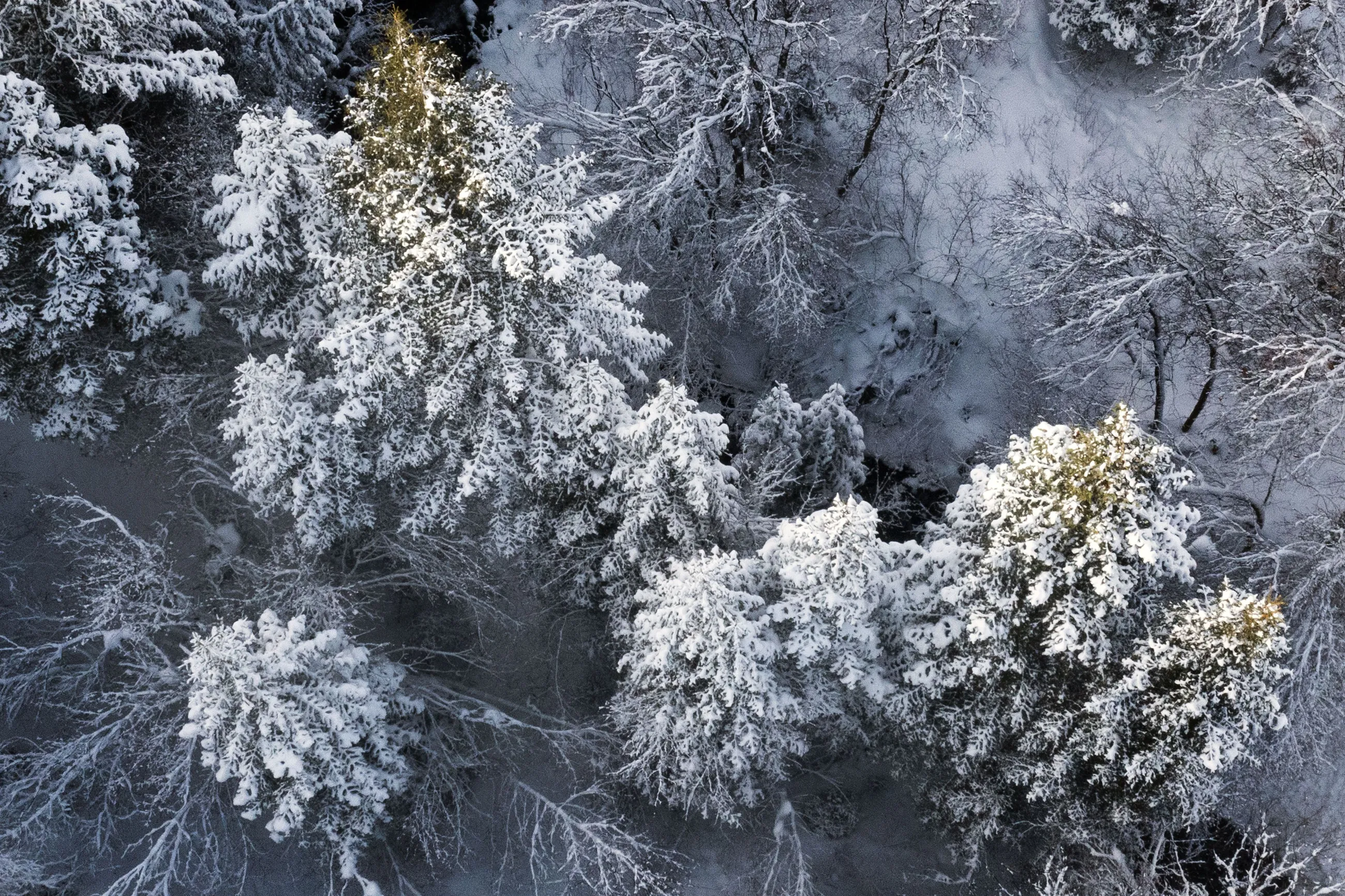
Snow-covered pine trees are pictured in the Wasatch-Cache National Forest in Millcreek on Thursday, Jan. 12, 2023. (Laura Seitz, Deseret News)
(Laura Seitz, Deseret News)
This article is published through The Great Salt Lake Collaborative: A Solutions Journalism Initiative, a partnership of news, education and media organizations that aims to inform readers about the Great Salt Lake.
Groups implore governor, Utah Legislature to examine issue.
Pointing to research they say backs their position that too many Utah trees are gobbling up a precious resource — water that would otherwise make it to the Great Salt Lake — a Salt Lake County Council member with support from others penned a letter to Utah’s governor and the house speaker begging them for active forest management, especially in the Wasatch.
Salt Lake County Council member Dea Theodore said watershed restoration is the key to saving the lake, which has dwindled to less than half its size and threatens to shrink even more due to drought and consumptive uses.
“Utah’s forests, many of which are largely overgrown and frequently unhealthy, contain roughly 7.6 billion trees. The trees in our overgrown forests and other non-native, noxious trees along our rivers and streams are consuming trillions of gallons of water that would otherwise flow downstream to the Great Salt Lake,” says her letter and fact sheet.
“Many of our forests are already in desperate need of tree thinning due to high and extreme fire danger. Many of these forest areas are in the central Wasatch Mountain in my council district. The thinning of those same trees would restore over 1.5 million acre-feet of water per year to the Great Salt Lake; enough to have the lake on its way to restored water levels over the next five years.”
The letter, which was sent Friday, is focused on overgrown forests in the Great Salt Lake Basin’s watershed using active management that includes mechanical means, prescribed burns and logging overgrowth.
Supporters include Reps. Carl Albrecht, R-Richfield; Phil Lyman, R-Blanding; Ken Ivory, R-West Jordan; and some commissioners from the Sevier, Kane, Piute, Iron and San Juan counties. The group also includes Mike Styler, who served in the Utah Legislature and as the former director of the Utah Department of Natural Resources, and helped craft the establishment of Utah’s Watershed Restoration Initiative, which has restored nearly 740,000 acres of critical watershed.
“Decades ago, the U.S. Forest Service, joined by city, county, and state officials planted millions of trees. Unfortunately, there have not been adequate management practices put in place to thin and adequately maintain the forests and land. This has resulted in unacceptably high and dangerous overgrowth and wildfires,” Theodore stressed.
“Additionally, non-native, water-guzzling trees and plants have spread like a scourge along our creeks, streams, rivers, and more. Unchecked growth has led to the loss of trillions of gallons of water each year that would otherwise flow to the Great Salt Lake,” she said.
She pointed to the Russian Olive and Tamarisk as non-native trees that take up an extraordinary amount of water that have already been under target by landscape conservationists for years.
The problem with trees
Theodore pointed to a Purdue University report on landscapes that said trees can absorb between 10 and 150 gallons (yes, 150) of water daily, with the Forest Service adding that a healthy, 100-foot tree can take 11,000 gallons of water from the soil in just one growing season.
Theodore and her supporters reject the recent call-to-arms report by university scientists and advocates that warned Utah lawmakers are not doing enough to save the Great Salt Lake in a water system that doesn’t encourage conservation enough and favors farmers’ crops and rangelands. It said if drastic changes aren’t made in consumption, the lake will be dry in five years.
“We do not accept that the Great Salt Lake should be dry within five years. The data shows that with proper forest management and tree thinning, the Great Salt Lake should be well on its way to sustainable water levels within five years,” Theodore said.
Fewer trees, she and her supporters say, are the answer, asserting that thinning forests has been proven to save a substantial amount of water for watersheds and drought-stricken areas.
Over an 18-year period in California, fire-thinned forests saved 3.7 billion gallons of water annually in California’s Kings River Basin and 17 billion gallons of water annually in the American River Basin — water that would otherwise have been lost through evapotranspiration, a study funded by the National Science Foundation said.
James Roche, a National Park Service hydrologist and lead author of the study, said it demonstrates the need for forest restoration to supply the benefit of increased water yield from watersheds.
Additionally, Forest Service research ecologist Eric Knapp and his colleagues established “experimental” forests in California in research detailed 10 years ago that showed severe drought killed 147 million trees statewide. Yet the thinned forests that were treated came through relatively unscathed, experiencing far less tree mortality than the adjacent unthinned areas, the report said.
“By reducing competition, the remaining trees had greater access to sunlight, water and the nutrients found in soil,” the research said.
Roadblocks, money and lawsuits
Theodore and her supporters hope to get the issue before the state Legislature in a short 45-day time span and convince them this is a viable way to help pump up water levels in the Great Salt Lake.
Watershed restoration projects, too, have met their share of opposition, including lawsuits by environmental advocacy groups opposed to mechanized thinning or treatments. Prescribed burns bring up air quality concerns and are put off altogether due to the area’s pollution problem. Some assert the thinning could be industry driven, but the logging industry in Utah has been tepid for years.
In addition, some of those controlled burns have gotten out of control, sometimes leaving a disastrous aftermath.
Then there is money. At one time, there were 1.3 million acres of U.S. Forest Service lands approved for treatment, but the total cost was $300 million, officials said, and the federal agency’s budget is chewed up by reactive firefighting costs rather than proactive fuels treatments.
Private landowners have indicated an interest, however, in participating in projects to thin forests and Theodore has bounced around the idea of incentivizing those owners by possibly creating new water rights by tree thinning or carbon credits for watershed restoration, reforestation and wildfire prevention.
“Fortunately, the necessary technology and systems seem to already be in place, just waiting to be scaled up and funded,” she said.
On Tuesday, the clock on that 45-day session begins ticking.
Related:
- Education, water are big issues in 2023 Utah Legislative Session, expert says
- Will December’s big storms make a difference for the Great Salt Lake?
- How the Great Salt Lake lakebed could contribute to pollution, other issues