What Utah can learn from the monumental effort to reduce dust at Owens Lake
Oct 13, 2022, 9:00 AM | Updated: 2:37 pm
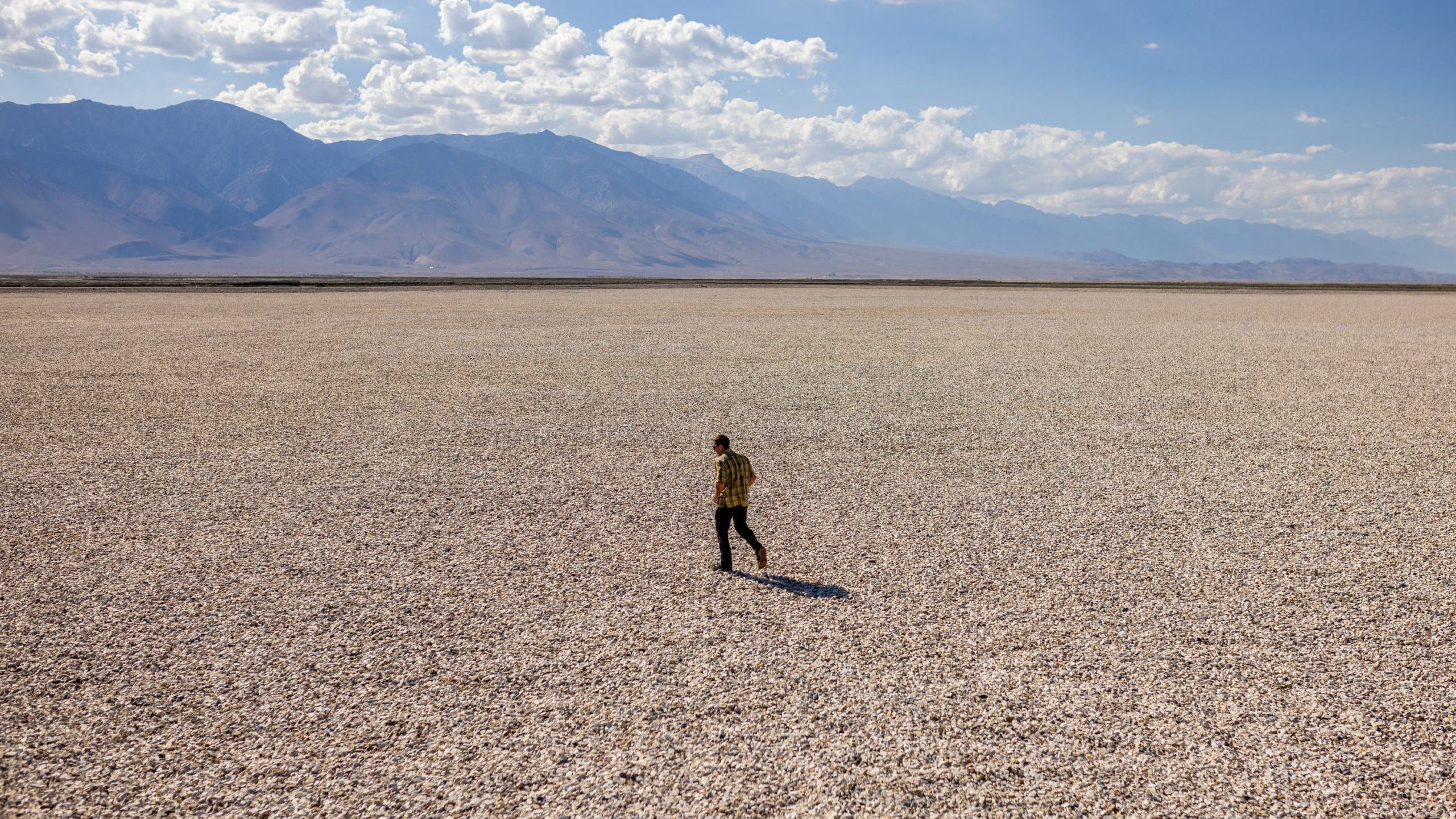
Phill Kiddoo, air pollution control officer for the Great Basin Unified Air Pollution Control District, looks at an area of the Owens Lake Dust Mitigation Program that has been converted to gravel on the dry lakebed in Inyo County, California, while giving journalists a tour on Wednesday, Aug. 10, 2022. Gravel is one of the “best available control measures” used to mitigate dust that would otherwise be kicked up from the dry lakebed.
This article is published through the Great Salt Lake Collaborative, a solutions journalism initiative that partners news, education, and media organizations to help inform people about the plight of the Great Salt Lake.
KEEPING EMISSIONS AT BAY ON THE GREAT SALT LAKE’S EXPOSED BED WILL TAKE A MOSAIC OF SOLUTIONS. AND IT WILL BE VERY, VERY EXPENSIVE.
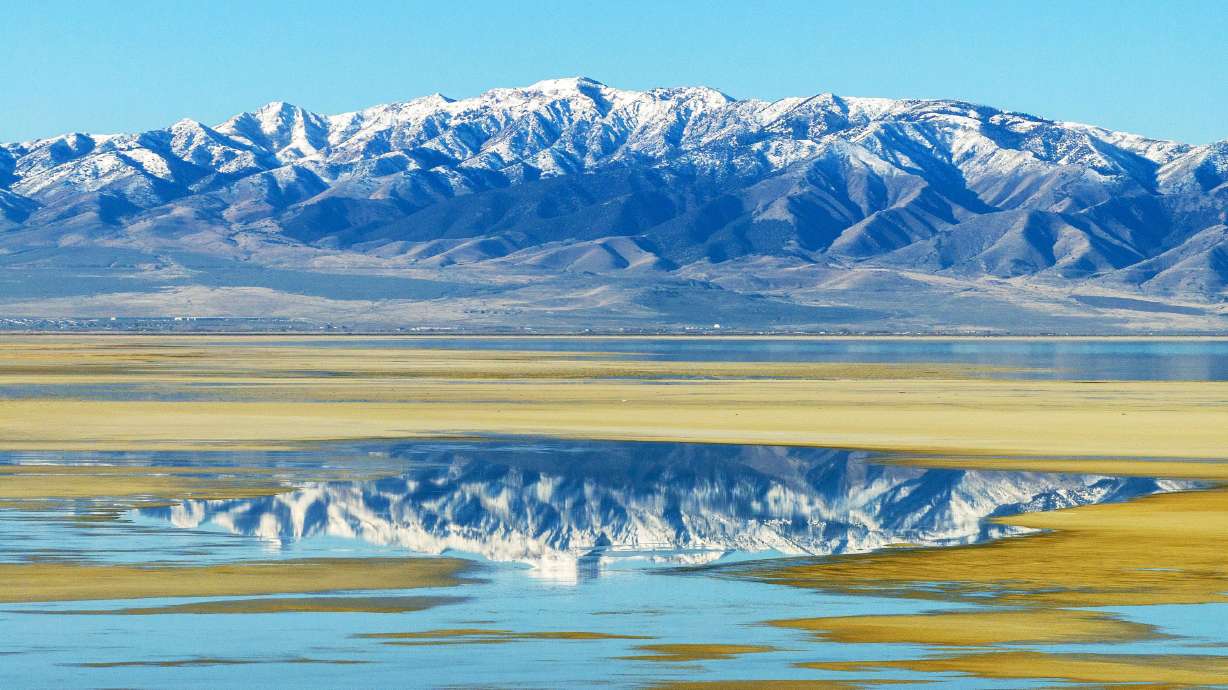
Owens Dry Lakebed, Calif. • The dust is kicking up on the Great Salt Lake’s ever-expanding dry lakebed, raising fears about the air millions breathe along the Wasatch Front.
Just a few states away, however, the Los Angeles Department of Water and Power has spent decades figuring out how to get a handle on its own dangerous sand and salt storms blowing from Owens Lake.
Until recently, the lake, dried to dust by L.A.’s water diversions, was the nation’s largest source of human-caused PM10 pollution.
These days, the problem is largely under control.
“The most remarkable thing is that we don’t have to look far to understand what the impacts have been to other terminal lakes,” said Laura Vernon, Great Salt Lake coordinator for the Utah Division of Forestry, Fire and State Lands. “And we don’t have to look far for solutions either.”
Vernon’s division manages the Great Salt Lake’s lakebed, and she said her team will likely be the ones charged with finding contractors and developing mitigation plans if it, too, becomes a major source of dust.
One big lesson from the Owens Lake efforts is that there’s no one-size-fits-all remedy to a massive source of lakebed pollution. At Owens Lake, LADWP created a mosaic of control measures that work better under various conditions in various places. It’s a site of impressive engineering upon which Utahns might, one day, need to draw.
Here’s what the pollution control measures look like on the ground:
Recovering the desiccated lakebed with water is the most obvious solution to healing a dried-up lake. But to LADWP, water is a precious commodity, and the idea is to use as little as possible.
That’s why crews built berms across the lake — which used to be up to 50 feet deep — that they fill with a few inches of water. It’s a method called shallow flooding.
“At the beginning, we had really tight deadlines,” said Arrash Agahi, who oversees the utility’s regulatory compliance at Owens Lake. “The easiest thing to do was create a big bathtub and turn on the water.”
Roughly two-thirds of the lake’s mitigation area uses standing water or wetted soils during the dust season, which runs from mid-October to late June.
The downside to shallow flooding, at least from LADWP’s perspective, is that it still requires a lot of water. On average, the utility uses 60,000 acre-feet a year for dust control, enough to supply all the businesses and residents of Long Beach. That’s also about a third of the freshwater supply available in the Owens Lake area, water the city instead could be piping down to its 4.3 million residents.
“It took seeing how much water we were using out here,” Agahi said, “… to come to the realization that was not something sustainable, considering climate change.”
And it’s something those managing dust at the Great Salt Lake might need to consider, particularly as a mushrooming population and the current “megadrought” put Utah’s future water supplies at risk.
But rewatering the lake had the admittedly unplanned side benefit of bringing back bugs, long-dormant brine shrimp and migratory birds.
“It wasn’t intentional,” Agahi said. “But once the birds were here, [they] became our responsibility to manage.”
TILLAGE
In an effort to tap less water, L.A. borrowed an idea from an employee with a background in agriculture.
Crews wet lakebed soils, then a tractor drags a plow to create a landscape of furrows and trenches, not unlike a farmer’s field in spring. They call the method “tillage.”
The roughened surface slows surface wind speeds, and the dirt clods are less likely to erode into dust.
L.A. officials like tillage because it’s cost effective, at around $500,000 per square mile to install (although it costs more than $1 million a year to monitor). It also requires little to no water to maintain — as long as the clods and furrows remain intact.
“When it rains,” Agahi said, “sometimes that gets washed out, and we need to do some maintenance.”
But Phill Kiddoo, pollution control officer for Great Basin Unified Air Pollution Control District, is less enthusiastic about tillage, noting it has “mixed results.”
“Tillage, it’s a tough nut to crack,” said Kiddoo, whose district is charged with overseeing the mitigation efforts and ensuring LADWP achieves federal air quality standards. “It’s worked very, very well in certain places that had a durability of 12 years. It failed miserably in certain areas because they’re too sandy.”
It’s also destructive, which is why the utility and regulators avoid using tillage in archaeologically and culturally sensitive areas.
GRAVEL
In some sections of Owens Lake, LADWP workers spread a staggering amount of gravel, covering multiple square miles in places. They found that a 4-inch layer of rocks placed directly on soil, or a 2-inch layer placed on fabric prevents emissive salts from rising to the surface.
L.A. officials called it the “best” measure they’ve tried.
“When done correctly and protected well, it’s probably some of our least maintenance-requiring dust control,” Agahi said. “So it’s a big benefit in that way.”
Notably, it also requires no water.
But gravel, too, has major caveats. It’s expensive, Agahi said, coming in at around $36 million per square mile.
That vast landscape of gravel also soaks in a lot of the desert heat, making for an unpleasant microclimate.
“It doesn’t have an aesthetic component,” Kiddoo said. “It has no benefit to wildlife.”
And it doesn’t work everywhere. A big section is slowly sinking into the lakebed near a brine pool at the lake’s center, Kiddoo said, amounting to an expensive lesson.
MANAGED VEGETATION
Meadows of native, drought-tolerant plants protect the lakebed surface from wind and capture any dust that blows by. But using vegetation as dust control isn’t as simple as it sounds. The plants take a few years to establish. They need to be irrigated in the meantime, and rodents tend to chew up drip lines.
“The voles absolutely love it,” Kiddoo said.
Managed vegetation is beginning to seed and spread across Owens Lake in the areas where the plants are best suited, including spots with springs and soils that aren’t overly saline.
“The environment around the lake doesn’t know that lake is gone yet,” Kiddoo said, “and so that artesian pressure from the subsurface is still pushing water up to the lake level. … It’s great for vegetation.”
But LADWP sees the naturally spreading greenery as a mixed bag. The plants can trick satellites used to monitor mitigation efforts into thinking wet areas are actually dry. And the grasses and shrubs don’t necessarily spread in thick enough densities to meet dust control criteria.
BRINE AND BRINE POOL
At the heart of Owens Lake, there’s still water — it’s just super salty and capped by a mineral rime.
“Like with the Great Salt Lake, there will always be water to a certain extent,” Kiddoo said. “The water gets so hypersaline that there’s no evaporation, so you get this brine pond or brine pool.”
The brine pool and its salt crust also keep a significant portion of the lakebed from becoming emissive. That’s why LADWP has had to mitigate only about half of the dry lake’s footprint.
LADWP tried to replicate this effect on the mitigation area’s fringes, flooding ponds with brine instead of fresh water and encouraging formation of a crust. But the salts can turn into polluting dust in the period before the brine completely dries. That means the utility has to use valuable fresh water as a backup control.
HOW WOULD UTAHNS PAY FOR ENGINEERED DUST CONTROL AT THE GREAT SALT LAKE?
None of these methods is particularly cheap. LADWP has shelled out $2.5 billion to clear the air at Owens Lake to date, installing an astounding 4,200 miles of pipe, and the utility likely will be there in perpetuity doing monitoring and maintenance.
The colossal effort rehabilitated around 50 square miles of lakebed, roughly the size of San Francisco. But the Great Salt Lake has about 800 square miles currently exposed.
Vernon’s division has around $7 million it collects annually from salt and mineral harvesting business at the Great Salt Lake. It’s money the state can tap to help the lake heal, but it also depends on those businesses remaining viable.
The efforts at Owens Lake show that water works best in reviving a drying lake, Vernon said, and getting water to the Great Salt Lake is the only method Utah is focused on for now.
“It’s the simplest solution, really,” Vernon said. “It’s better than all the expensive alternative solutions.”
Related:
- The public trust doctrine prevented Mono Lake from drying up. Could it be used to save the Great Salt Lake?
- Cloud seeding: a potential save for the Great Salt Lake
- The saline lakes of the Great Basin and why they are in trouble