Go green? A voter’s guide to Prop 2
Oct 22, 2018, 10:40 AM | Updated: Nov 8, 2022, 11:40 am
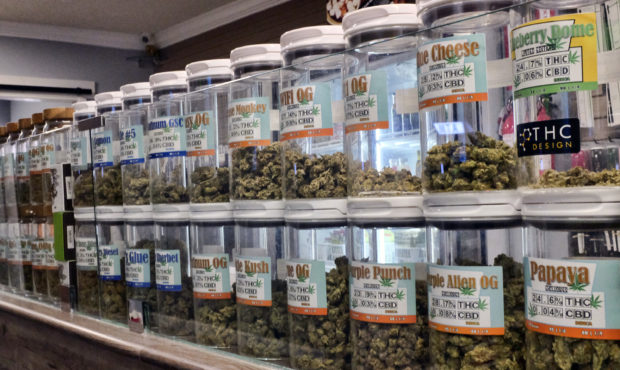
File photo of a medical marijuana display in Los Angeles. (AP Photo/Richard Vogel, File)
(AP Photo/Richard Vogel, File)

For better or worse, no initiative on the ballet this November has caught Utah’s interest like Proposition 2. The controversial medical cannabis initiative has captured the attention of lawmakers, voters, and media members alike.
But passion breeds misinformation, and our state’s conversation on the proposition often seems to inspire more confusion than clarity.
What is Prop 2? What are the legal specifics, and how do they interact with existing laws? What fiscal, medical and social impacts might passing Proposition 2 have on our state? Here’s KSL’s breakdown.
The Status Quo
As a federally controlled substance, cannabis (also known as marijuana) is subject to both state and federal laws. Cannabis remains illegal at the federal level and is classified by the Drug Enforcement Agency as a “Schedule I” drug, meaning the DEA has judged it to have no currently accepted medical use and a high potential for abuse.
Utah state law currently includes a deadline — January 1, 2019 — by which the state must ensure that it can grow, process and sell cannabis. The catch: the state is the only party licensed to grow or sell cannabis, and they may only sell it to qualified research institutions or terminally ill Utahans with less than six months to live.
Growth, distribution, and possession of cannabis by citizens are all illegal under current state law.
Proposed Changes
Proposition 2 would not eliminate Utah’s existing cannabis-related law — the state would still be required to make available the growth, medical processing, and sale of cannabis by January 1st, 2019.
But voter approval of Proposition 2 would open up parallel growth, testing and distribution procedures to private entities.
It would also expand the group of people eligible to use medical cannabis by removing the terminal illness requirement and establishing a process for obtaining a doctor’s approval.
In regards to technical specifics, Prop 2 would authorize the establishment of four types of cannabis facilities: cultivation facilities (commonly referred to as “grow houses”), processing facilities, testing facilities and dispensaries.
It would mandate that facilities use a detailed inventory system accessible to the state for random inspections that the state may conduct at any time.
It would also limit the numbers of licenses granted for various parts of the growth and distribution processes.
For instance, only 15 cultivation licenses will be granted until 2022, at which point the state will reevaluate questions of supply and demand for medical cannabis.
Dispensary licenses will be granted according to population, with the total number of dispensaries allowed in any county to be determined by the number of county residents divided by 150,000 and rounded up to the nearest greater whole number.
Prop 2 includes specific requirements and limitations about cannabis packaging, labeling, and advertising. All packaging must “clearly and unambiguously state” that the product contains cannabis and include the specific amount of tetrahydrocannabinol, or THC — cannabis’ primary psychoactive compound — in the product.
Packaging must be tamper-evident, opaque, child-proof and not designed to appeal to children in any way, including looking like popular brands of candy.
To obtain a medical cannabis prescription (or “medical card”), patients must be at last 18 years old (or the legal guardian of an underage patient), have a “qualifying illness,” and receive a recommendation from a doctor.
Qualifying conditions include:
– HIV
– Alzheimer’s disease
– Amyotrophic lateral sclerosis, or ALS
– Cancer, cachexia, or a condition manifest by physical wasting, nausea, or malnutrition associated with chronic disease
– Crohn’s disease, ulcerative colitis, or a similar gastrointestinal disorder
– Epilepsy or a similar condition that causes debilitating seizures
– Multiple sclerosis or a similar condition that causes persistent and debilitating muscle spasms
– Post-traumatic stress disorder
– Autism
– Rare condition or disease that affects less than 200,000 persons in the United States
Chronic or debilitating pain if a physician determines that the individual is allergic to opiates or is at risk of becoming chemically dependent or overdosing on opiate-based pain medication.
Proposition 2 also establishes a process for a person whose condition is not included on the list of qualifying illnesses to receive approval to use medical marijuana.
To receive approval, a person must provide satisfactory evidence to a five-member board of physicians that the person has a condition that is hard to control or deal with and substantially impairs the person’s quality of life, and the board must determine that medical marijuana use is in the person’s best interest.
Prop 2 even establishes limits on cannabis use by those with medical cards. Cardholders are prohibited from consuming marijuana via smoking (prop 2 allows for vaporizing, consuming concentrates and edibles, and tropical-style medications), prohibited from using cannabis while driving, and prohibited from using marijuana in public except in a medical emergency.
If carrying cannabis outside of their personal residence, they are required to carry proof that they are approved to use medical marijuana and only carry cannabis in limited, clearly-labeled quantities.
Finally, Proposition 2 would establish a database of all medical recommendations that would allow police officers access to information on citizens’ eligibility to possess medical marijuana.
Fiscal Impact
Proposition 2 exempts medical marijuana sales from state and local sales tax. Instead, it requires the state to impose fees, including licensing and registration fees paid by cannabis facilities, to cover the ongoing costs of implementing the Proposition.
In the first year, Proposition 2 may cost the state $3.6 million, an amount that includes one-time setup costs. Some of the first year’s initial setup costs will have to be paid before the state begins collecting fees, requiring the state to pay $1.3 million from state tax revenue.
After the first year, the annual revenue from fees is expected to cover the Proposition’s estimated annual cost of $2.1 million, making it a self-sustaining program.
Arguments in Favor of Prop 2
Passing Proposition 2 would make Utah the 30th state to approve medical cannabis and affirm the 75% of Utahans that support a path to medical marijuana legalization.
Proponents claim it would decriminalize patients currently treating their illnesses with cannabis and stop creating “medical refugees” of Utahans who leave the state to obtain legal access.
Proposition 2 would be the only medical marijuana program in the country that bans both smoking and home cultivation, making it one of the nation’s most conservative cannabis measures.
The Utah Patients Coalition, who provided the affirmative arguments for the state’s nonpartisan write-up on Prop 2, describe it as a “cautiously crafted bill, written with Utah values in mind.”
They claim it includes regulations that ensure only patients can access medical cannabis and that it gives law enforcement significant oversight.
The Patients Coalition argues that Prop 2’s technical specifics would prevent an increase in marijuana abuse or use by people who are underage.
Proponents of Prop 2 also frequently argue that legalizing medical marijuana would decrease patients’ dependence on opiate medications and meaningfully impact Utah’s opioid crisis.
Arguments Against Prop 2
State Senator Evan Vickers and State Representative Brad Daw, who wrote the state’s arguments in opposition, claim that Prop 2 “implements a de facto recreational marijuana policy in Utah.”
They argue that too many people would be licensed to approve patients and that the use of dispensaries instead of pharmacies would “violate the safeguards of legitimate medicine.”
Vickers and Daw also claim the dosing procedures — or lack thereof — are too general, and that doctors should recommend appropriate dosages to individual patients rather than imposing a one-size-fits-all upper limit on how much cannabis patients can purchase every two weeks.
Opponents of Prop 2 also raise concerns about increases in youth marijuana use, traffic fatalities, and crime.
Additional Information
More information on the specifics of Proposition 2, the medical benefits of cannabis, and the potential harms of medical legalization can be found here.