Israel signs peace pacts with two Arab states
Sep 15, 2020, 3:22 PM
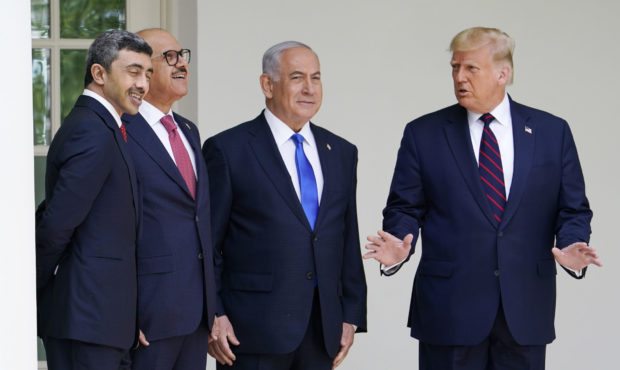
President Donald Trump walks to the Abraham Accords signing ceremony at the White House, Tuesday, Sept. 15, 2020, in Washington with Israeli Prime Minister Benjamin Netanyahu, Bahrain Foreign Minister Khalid bin Ahmed Al Khalifa and United Arab Emirates Foreign Minister Abdullah bin Zayed al-Nahyan. (AP Photo/Alex Brandon)
(AP Photo/Alex Brandon)
WASHINGTON (AP) — Israel on Tuesday signed historic diplomatic pacts with two Gulf Arab states at a White House ceremony that President Donald Trump declared will mark the “dawn of a new Middle East,” casting himself as an international peacemaker at the height of his reelection campaign.
The bilateral agreements formalize the normalization of Israel’s already thawing relations with the United Arab Emirates and Bahrain in line with their common opposition to Iran. But the agreements do not address the decades-long conflict between Israel and the Palestinians, who view the pacts as a stab in the back from their fellow Arabs and a betrayal of their cause for a Palestinian state.
Hundreds of people massed on the sun-washed South Lawn to witness the signing of agreements in a festive atmosphere little marked by the coronavirus pandemic. Attendees did not practice social distancing and most guests didn’t wear masks.
“We’re here this afternoon to change the course of history,” Mr. Trump said from a balcony overlooking the South Lawn. “After decades of division and conflict, we mark the dawn of a new Middle East.”
Under the agreements, the countries have committed to exchange embassies and ambassadors and to cooperate on a broad array of issues, including education, healthcare, trade and security.
Israeli Prime Minister Benjamin Netanyahu said the day “is a pivot of history. It heralds a new dawn of peace.”
Neither Netanyahu nor Pres. Trump mentioned the Palestinians in their remarks, but both the UAE and Bahraini foreign ministers spoke of the importance of creating a Palestinian state.
Emirati Foreign Minister Sheikh Abdullah bin Zayed Al Nahyan, the brother of Abu Dhabi’s powerful crown prince, even thanked Netanyahu for “halting the annexation” of West Bank land claimed by the Palestinians in exchange for Emirati recognition. Netanyahu, however, has insisted that Israel has only temporarily suspended its plans to annex West Bank settlements.
“Today, we are already witnessing a change in the heart of the Middle East — a change that will send hope around the world,” al-Nahyan said.
Bahrani Foreign Minister Abdullatif al-Zayani said Bahrain would stand with the Palestinians. “Today is a truly historic occasion,” he said. “A moment for hope and opportunity.”
But in the Gaza Strip, Palestinian militants fired two rockets into Israel, apparently meant to coincide with the ceremony. The Israeli military said the rockets were fired from Gaza and one was intercepted by air defenses. Earlier in the day, Palestinian activists held small demonstrations in the West Bank and in Gaza, where they trampled and set fire to pictures of Mr. Trump, Netanyahu and the leaders of the UAE and Bahrain.
There are no active wars to be ended by the agreements, but Israel and the U.S. hope they could usher in a major shift in the region should other Arab nations, particularly Saudi Arabia, follow suit. That could have implications for Iran, Syria and Lebanon. Until now, Israel has had peace deals only with Egypt and Jordan.
Other Arab countries believed to be close to recognizing Israel include Oman, Sudan and Morocco.
“We are very down the road with about five different countries,” the president told reporters before the ceremony.
Skeptics, including many longtime Mideast analysts and former officials, have expressed doubts about the impact of the signings.
In addition to the bilateral agreements signed by Israel, the UAE and Bahrain, all three signed a document dubbed the “Abraham Accords” after the patriarch of the world’s three major monotheistic religions.
During the signing ceremony, the leaders were seated at a long table where President Harry S. Truman once held weekly luncheon meetings with his Cabinet. Discussions about the Truman Doctrine to restrain Soviet expansion during the Cold War and the Marshall Plan to send billions in economic aid to Western Europe after World War II were held at the table.
The stagecraft, including live music and flags, was meant to evoke previous Middle East agreements. Pres. Trump’s political backers are looking to boost his standing as a statesman with just seven weeks to go before Election Day. Until now, foreign policy has not had a major role in a campaign dominated by the coronavirus, racial issues and the economy.
Besides Republicans, a few House Democrats attended the event, a notable development at a time when their leader, House Speaker Nancy Pelosi is barely on speaking terms with the president. Many Democrats, including presidential nominee Joe Biden, widely support the deal.
Rep. Elaine Luria, D-Va., said she accepted the invitation immediately on receiving it over the weekend. “It definitely was a monumental event, and the ceremony was very fitting for that,” Luria, a member of the House Armed Services Committee, said in a telephone interview afterward.
Like Luria, some other Democrats in attendance, such as Rep. Anthony Brindisi of New York, are freshmen in tough reelection races. Still others, such as Florida Reps. Ted Deutch and Stephanie Murphy hail from districts with large numbers of Jewish constituents.
Questions remain, however, about the significance of the agreements. Even in Israel, where the accords have received widespread acclaim, there is concern they might result in U.S. sales of sophisticated weaponry to the UAE and Bahrain, thus potentially upsetting Israel’s qualitative military edge in the region.
Mr. Trump said he is OK with selling military aircraft to the UAE. Pelosi also welcomed the agreements but said she wants to learn details, specifically what the Trump administration has told the UAE about buying American-made F-35 aircraft and about Israel agreeing to freeze efforts to annex portions of the West Bank.
The UAE and Bahrain have a history of suppressing dissent and critical public opinion, but there have been indications that the agreements are not nearly as popular or well-received as they are in Israel. Neither country sent its head of state or government to sign the deals with Netanyahu.
Bahrain’s largest Shiite-dominated opposition group, Al-Wefaq, which the government ordered dissolved in 2016 amid a yearslong crackdown on dissent, said there is widespread rejection of normalization. Al-Wefaq joins other Bahrainis who reject the agreement to normalize ties with the “Zionist entity,” and criticized the government for crushing the public’s ability to express their discontentment with normalization.
The ceremony followed months of intricate diplomacy headed by Jared Kushner, Mr. Trump’s son-in-law and senior adviser, and the president’s envoy for international negotiations, Avi Berkowitz. On Aug. 13, the Israel-UAE deal was announced. That was followed by the first direct commercial flight between the countries, and then the Sept. 11 announcement of the Bahrain-Israel agreement.
___
Associated Press writers Aya Batrawy in Dubai, United Arab Emirates, Laurie Kellman in Washington and Joseph Krauss in Jerusalem contributed to this report.