EXPLAINER: How do other democratic nations select leaders?
Dec 13, 2020, 5:12 PM
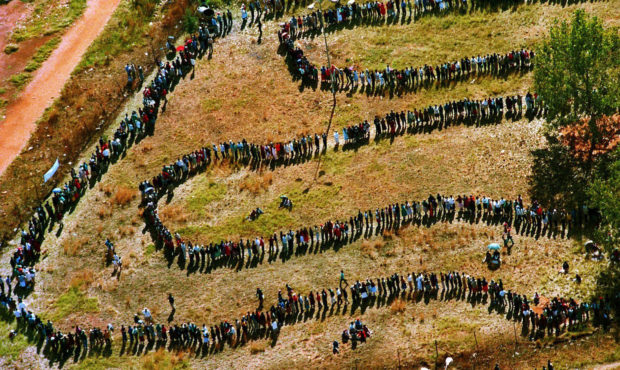
FILE - In this April 27, 1994, file photo, people queue at a primary school to cast their votes at a polling station in Soweto, South Africa, as the country went to the polls in the country's first all race elections. In other democratic countries, heads of government are either directly elected by voters or by a parliamentary system in which the party winning the most seats in the national assembly selects the head of state. (AP Photo/Denis Farrell. File)
(AP Photo/Denis Farrell. File)
The way the United States will formally choose its president on Monday stands in stark contrast to how most of the world’s democracies select leaders.
In other democratic countries, heads of government are either directly elected by voters or by a parliamentary system in which the party winning the most seats in the national assembly selects the head of state.
Some processes are complex and intricate, others more straightforward. Here is a look at how some of those countries choose their leaders — and how complications can arise.
SOUTH AFRICA
In South Africa, which held its first all-race elections in 1994, citizens vote for political parties rather than for candidates. The president is then chosen in a vote by the National Assembly. The party that won the majority of seats would be able to elect its own leader as president. The African National Congress, the liberation movement turned political party, has dominated politics since Nelson Mandela became president in 1994. In 2019, however, the ANC obtained its weakest victory, winning only 57% of the vote.
POLAND
In Poland, its democracy reborn in 1989 after the fall of communism across eastern Europe, a candidate who gets at least 50% of the popular vote becomes president. If no candidate gets at least 50%, a second round pits the top two vote-getters against each other. There has only been only one first-round winner, with the re-election in 2000 of Aleksander Kwasniewski, a former communist who transformed himself into a pro-democracy figure. Even Lech Walesa, the famous founder of Poland’s anti-communist Solidarity movement, needed a second-round vote to become Poland’s first popularly elected president.
SPAIN
In Spain, the Congress of Deputies elects the prime minister. The party that wins the most seats but falls short of a majority must form alliances with other parties to select the country’s leader. In 1996, this led to an awkward situation for the would-be prime minister. As votes were being counted, Jose Maria Aznar’s conservative Popular Party thought it won enough seats to make him prime minister. Supporters, celebrating outside party headquarters in Madrid, aimed an ugly chant at Jordi Pujol, a diminutive politician from the autonomous region of Catalonia, where Catalan is spoken. “Pujol, you dwarf, speak in Spanish!” they chanted. They had to swallow those words a few hours later when final results showed Aznar needed the votes of Pujol’s coalition to win easy election as prime minister. The conservatives wound up humbly wooing Pujol’s coalition and offering Catalonia even greater autonomy.
UNITED KINGDOM
U.K. voters elect a lawmaker for their local area. Then, the party that wins the largest number of the 650 constituencies generally takes power, with the party leader becoming prime minister. A coalition government might be formed if no party wins a majority of seats. The winning party is almost always the one that took the biggest share of the popular vote. It is rare for any party to win a majority of the popular vote because several parties compete. Boris Johnson’s Conservatives got 44% of the popular vote in the 2019 election but won an 80-seat majority in Parliament, allowing him to remain as prime minister.
BRAZIL
Brazil chooses its president through direct election, held in two rounds unless the first-round winner gets more than 50% of valid votes. Voting is mandatory, leading to high turnout, and to a fair number of spoiled or blank ballots. In 2018, turnout was about 80%. The fine for failing to vote is less than a dollar.
SOUTH KOREA
The president is directly elected by a single-round, popular vote in which the candidate who gets the most votes wins outright. A person must be at least 40 years old to be eligible to run. The country’s current president, Moon Jae-in, won a by-election on May 2017, two months after South Korea’s Constitutional Court formally removed his conservative predecessor Park Geun-hye from office over a corruption scandal. She is now serving a prison term for abuse of power, bribery and other crimes.
TAIWAN
A constitutional amendment in 1994 instituted direct, popular elections for president. Previously, the office was filled indirectly by the National Assembly, dominated by the then-ruling Nationalist Party. The 1996 election marked the first time Taiwan selected its president by popular vote.
NEW ZEALAND
New Zealand’s prime minister is chosen by other lawmakers and typically is the leader of the party which gains the most votes in the election. Under New Zealand’s proportional voting system, parties must often form alliances to command a majority in the parliament. Although New Zealand functions as a fully independent and democratic nation, its head of state remains Britain’s Queen Elizabeth II. That means the prime minister must officially be approved by the Queen’s representative in New Zealand, the governor-general.
___
AP reporters Jill Lawless in London; Vanessa Gera in Warsaw, Poland; David Biller in Rio de Janeiro; Kim Tong-Hyun in Seoul, South Korea; and Nick Perry in Wellington, New Zealand, contributed to this story. Follow Andrew Selsky on Twitter at https://twitter.com/andrewselsky