Coffee is in danger. Starbucks is working on solutions
Oct 3, 2023, 10:55 AM
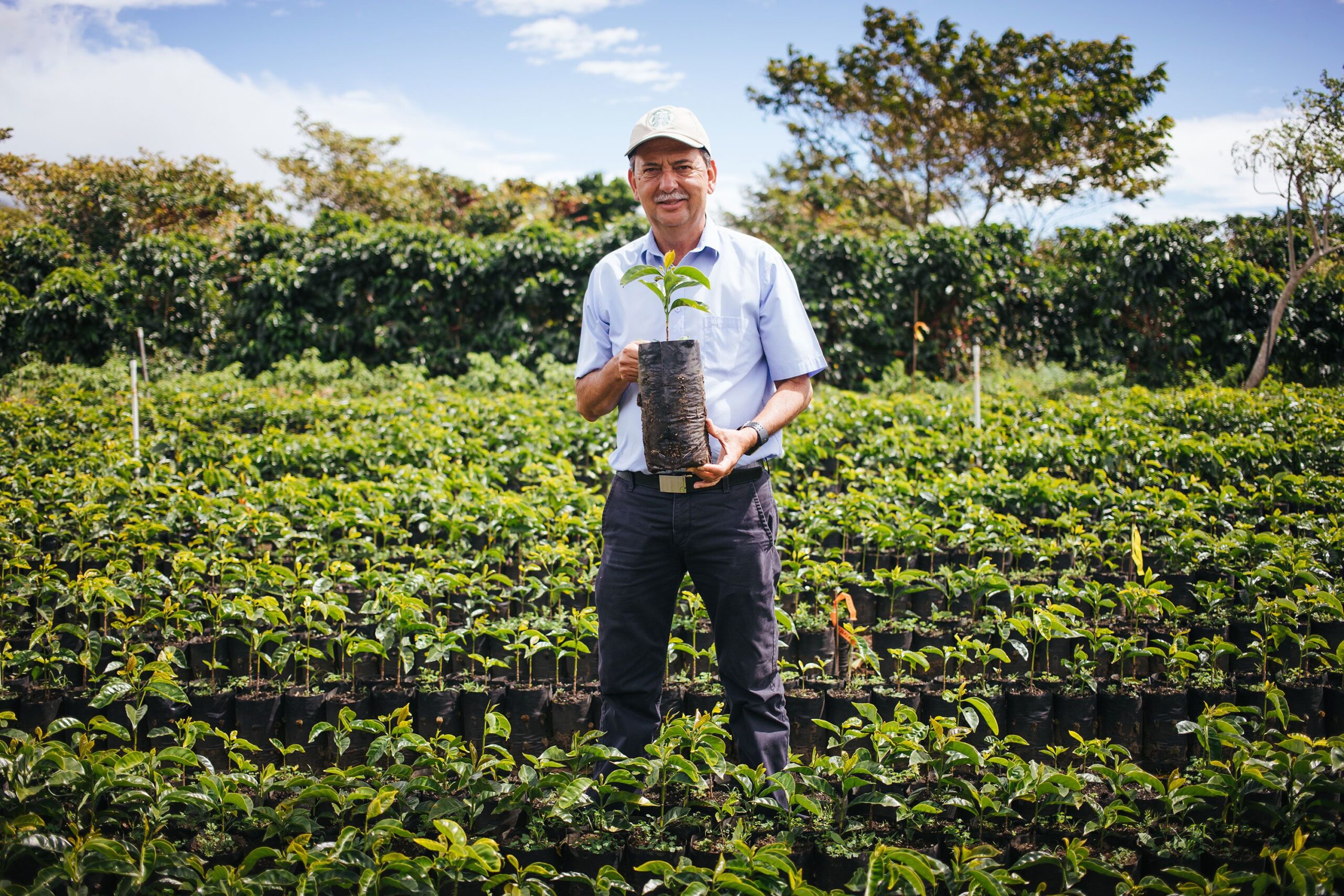
Starbucks director of global agronomy, Carlos Mario Rodriguez at the Hacienda Alsacia coffee farm. (Credit: Joshua Trujillo/Starbucks)
(Credit: Joshua Trujillo/Starbucks)
New York (CNN) — Coffee is a finicky crop — arabica coffee, the most popular variety, in particular. And climate change poses a huge threat to the coffee business and to farmers.
“To grow properly, coffee crops require specific temperature, light and humidity levels,” according to the Inter-American Development Bank, a financial institution serving Latin America and the Caribbean. Currently, those conditions are largely met in certain parts of Latin America, within a region called the coffee belt, a recent IADB report noted.
But by 2050, the bank warned, “rising temperatures will reduce the area suitable for growing coffee by up to 50%.” The changing climate could mean that some countries could newly accommodate coffee, IADB noted.
But for coffee to keep thriving where it is now, things have to change.
So Starbucks, which says it purchases about 3% of all the world’s coffee, is developing new arabica varietals that are specifically cultivated to hold up better on a warming planet. For more than 10 years, agronomists at Starbucks have been breeding different types of coffee trees, trying to find ones that will yield a high amount of fruit in a relatively short amount of time and, among other things, resist coffee leaf rust, a disease that attacks coffee trees and is exacerbated by climate change.
After pairing hundreds of varieties, the company has landed on six that fit the bill and meet the company’s standards for taste and flavor. A catalog describing Starbucks’ six new varieties is available to farmers at the company’s Hacienda Alsacia coffee farm, an educational and research center in Costa Rica.
The catalog lists the flavor profile for each plant. One makes coffee with notes of melon, honey and sugar cane, while another boasts a citrus, herbal, floral flavor. The catalog also outlines the plant’s growing characteristics, like the altitudes at which it will survive, the plant’s size and structure, and how many years it will take until first production.
“Some of the varietals that we’re working with and testing are seeing their harvest in [a] two-year cycle,” instead of three or four years, said Michelle Burns, executive vice president of global coffee, social impact and sustainability for Starbucks. If all goes well, that means more coffee more quickly, a win for Starbucks and its suppliers.
Climate comes for coffee
Starbucks, with nearly 36,000 locations across the globe is heavily reliant on farmers — it buys from about 400,000 farmers across 30 countries. They, along with other coffee farmers across the globe, are struggling to adapt to global warming.
Climate change has had a big impact on Suzanne Shriner, president of Lions Gate Farms in Hawaii, which isn’t a Starbucks supplier.
“Our rainfalls [have] become more intermittent, and when they come, they’re more severe, which is hard on the plants,” she said.
In Hawaii, Shriner said, farmers are working with World Coffee Research, a nonprofit that partners with the industry, including Starbucks, to to come up with a solution to coffee leaf rust, which has become a serious problem in the region.
“We’re looking for similar breeding innovations,” she said, “we’re watching the Starbucks program closely.”
Coffee is not the only crop threatened by climate change, of course. Drought, freeze or heavy rains can devastate yields across agricultural products from cocoa to grapes. And extreme weather is unpredictable, making it difficult for farmers to plan for these changes effectively.
But arabica coffee, the only variety used by Starbucks, is especially at risk.
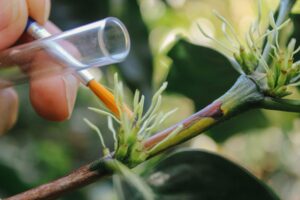
Starbucks has been working on developing new coffee varietals.
(Credit: Joshua Trujillo/Starbucks)
Fighting leaf rust
With arabica coffee, there is an “urgent need” to develop more climate-resistant varieties, said Miguel Gomez, a food marketing professor at Cornell’s Dyson School of Applied Economics and Management.
Current arabica plants “are not resistant to water stresses,” he said. “They tend to be more susceptible to diseases like leaf rust … that are present whenever you have unusually high temperatures.”
A coffee rust-resistant tree may be an attractive option for farmers. But it’s not going to fix the many problems posed by climate change, warned Monika Firl, senior advisor for Fairtrade International’s coffee program.
“No silver bullet is going to fix climate change for farmers,” she said.
Nature “adapts faster than the laboratory science does,” she added. Breeds that are optimized to thrive in certain conditions might falter in others — and so a solution might work for now, but not in the long term.
Firl thinks that in order for coffee to be sustainable, there needs to be a shift away from the industrialized coffee farm model. “We need to bring coffee back to its forest roots,” she said, to promote a healthy ecosystem.
In 2021, Starbucks made a commitment to invest in in forest protection and restoration, and set other climate-related goals. Burns described the company’s breeding program as an “ongoing” process, saying the company will keep trying out new varietals to adapt to climate change.
Other coffee varieties, like robusta and liberica, hold up better than arabica in these difficult conditions. But coffee makers tend to avoid these varieties because consumers like how arabica tastes and smells, Cornell’s Gomez noted. The goal is to develop varieties that taste like arabica but are more resilient, like other varieties.
Securing the coffee supply chain
In its most recent annual report, Starbucks pointed to “increases in the cost of high-quality arabica coffee beans… or decreases in the availability of high-quality arabica coffee beans,” as a supply chain risk that could have “an adverse impact on our business and financial results.”
It pointed to a number of factors that can affect coffee prices and supply. Bad weather, decreased water availability and crop diseases, among other problems, can all make coffee more expensive for Starbucks to buy, or limit supply altogether. “Climate change may further exacerbate many of these factors,” the report warned.
Even before Starbucks developed its own climate-resistant varieties, it had been offering climate-resistant seeds developed by others (and sometimes tweaked by Starbucks) to farmers.
Overall, it has given away three million seeds over the past five years, according to the company. In addition to the seeds, Starbucks has distributed about 70 million coffee rust resistant trees to farmers, as part of its goal to give out 100 million trees by 2025.
Related: BYU researchers introduce drought-resistant quinoa as nations face food challenges