Magnitude of Thursday’s earthquake near Evanston wasn’t out of the ordinary, officials say
Jan 22, 2026, 6:15 PM | Updated: 6:48 pm
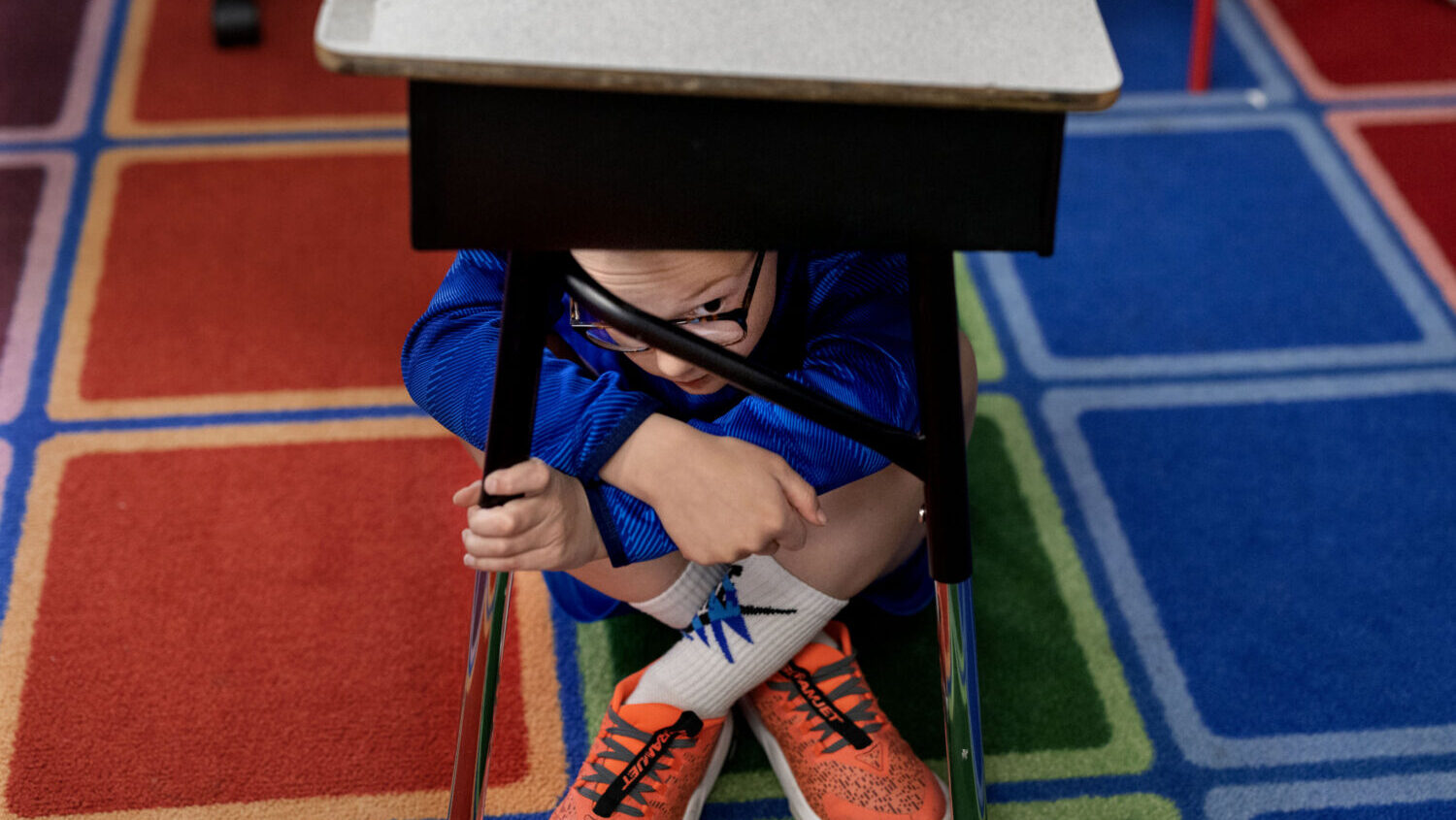
FILE: Third-grader Burke Neese participates in The Great Utah ShakeOut earthquake drill at Canyon View Elementary School. It was no drill on Thursday, Jan. 22, 2026, when a magnitude 5.7 quake was reported on the Utah-Wyoming border. (Laura Seitz, Deseret News)
(Laura Seitz, Deseret News)
SALT LAKE CITY — The magnitude 4.7 earthquake recorded in Utah near the Utah-Wyoming border on Thursday morning wasn’t out of the ordinary for quakes in this region.
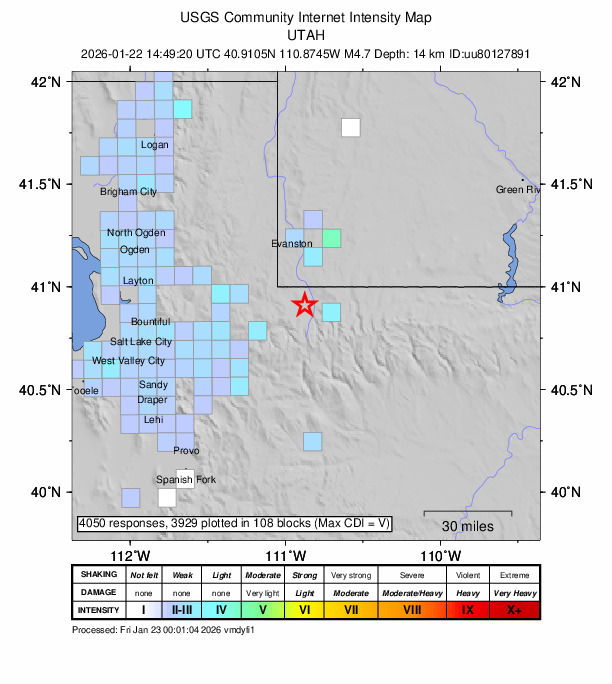
It happened at 7:49 a.m., MST. According to the U.S. Geological Survey it was located at the edge of the Wasatch National Forest 24.8 miles from Evanston, Wyoming.
By late Thursday afternoon, no damage had been reported.
But it was felt, according to people in Taylorsville, Salt Lake City, Pleasant Grove and Stansbury Park who called KSL NewsRadio. That jibes with data collected by the USGS showing that Utahns from Logan to Spanish Fork felt the shaking and reported from weak to light intensity.
Dr. Emily Morton, a seismograph research scientist at the University of Utah, said Utah has tiny earthquakes “all the time.” For them to to be felt, she said a quake needs to be between magnitude 2.5 to 3.
According to earthquaketrack.com, over the last week in Utah there have been temblors in:
- Oakley
- Mapleton
- Cedar City
- Panguitch
- Milford
- Entereprise, and
- Magna
These measured between magnitude 1.5 and 3.0.
Despite that list, Morton said her colleagues aren’t seeing upward trends in the number of quakes hitting Utah.
“We typically see, I want to say about 10 magnitude 3’s every year. It’s been fairly consistent, we would notice if something was increasing drastically,” Morton said, adding that her colleagues expect only one earthquake that ranks above four, each year.
Not unusual, but educational
If Thursday’s quake wasn’t out of the ordinary, Morton said it was exciting and educational for Utahns because the lack of damages or injuries allowed people to think instead about earthquake preparedness.
It was “big enough that people are feeling it,” she said, “but small enough that no one’s getting hurt.”
And it is those larger quakes, the type she said come along every decade or so, for which Utahns should be prepared.
The state’s most recent example was the magnitude 5.7 temblor recorded at 7:09 a.m. MDT on March 18, 2020. That earthquake struck about 3.7 miles north and northeast of Magna.
Even at magnitude 5.7, Utah’s 2020 earthquake resulted in no major injuries or damages though the economic loss reached to $629 million according to the Federal Emergency Management Agency.
Other reading:
- Magna earthquake helps scientists understand Utah’s vulnerability
- Study shows how earthquake monitors can track space junk through sonic booms
- How an earthquake impacts homes and buildings