Kyler had bipolar disorder: His story, from the beginning
Apr 6, 2024, 11:45 AM | Updated: Apr 8, 2024, 9:55 pm

SALT LAKE CITY — A Park City man died on New Year’s Day after breaching an emergency exit at Salt Lake City International Airport, crossing the tarmac shoeless, then climbing up and into the engine turbine of an airliner taxing away from the gate. What you can’t spot in the airport’s grainy surveillance video is that Kyler Efinger, 30, was suffering from bipolar disorder.
For Kyler, the first day of the year was his last day alive. He was pronounced dead at the scene.
His father, Judd Efinger, said his son was diagnosed with bipolar disorder 10 years ago.
Efinger spoke to Dave & Dujanovic about his son’s mental illness.
No one stopped to help
Efinger said of all the travelers passing through the airport that day, not one stopped to help or ask if Kyler needed help, nor did any airport workers.
“At one point, there’s a video of him sitting Indian-style on the moving walkway… and everyone’s just going to the side and avoiding him… He didn’t have a violent bone in his body. He needed someone to put their arm around him and say, ‘Hey buddy, what’s going on? Can I help you?”

Efinger said Kyler was “slightly hyperactive” as a child. He would greet each day with a trip down his bunk-bed slide.
“But he was never diagnosed with ADHD, but I would just say hyperactive,” Efinger said. “We’re actually trying to do some research on really whether ADHD is a precursor to some of these more serious mental disorders.”
Called to principal’s office
The earliest signs of Kyler’s mental disorder happened during his sophomore year in high school.
“He was bullied and — hard to know why bullies do what they do — but he was just a kid they enjoyed picking on and that continued through college,” Efinger said.
He added he was called into the principal’s office after Kyler — then a senior — got into a fight. The high school counselor recommended a therapist.
“I guess one of the things they bullied him on is ‘Hey kid, you need special help’ and so he always fought back against that,” Efinger said.
The first manic episode happened to Kyler at a fraternity house at 3 in the morning.
Rescuing his son from bipolar episodes
Efinger was there to help his son as he struggled through his manic bipolar episodes involving police and mental health professionals.
Efinger arrived at the frat house to find his son, Kyler, lying on the floor drenched in beer. His head has also been shaven.
Efinger was angry.
“It just grabs you right on your heartstrings,” Efinger said. “I happen to have a German temper as well. So there was a bit of temper going, and I just asked them all to leave the room because I wasn’t going to be able to deal with them, and they did respectfully, but yeah, it was just super tragic.”
‘Call the police’
Kyler had four “true” manic episodes during his 10-year battle, his father added. In some, Kyler experienced visions of grandeur.
“He thought he was Jesus Christ, and he was going to save the world. Other times it was more of a physical elevation. He wanted to run across the nature preserve in his underwear. All of those ended with us calling the police,” Efinger said.
Ten years ago when Kyler was experiencing his early manic episodes, Efinger said mental-health resources were more scarce than today. He said he would call the hospital to ask for help but was told to call the police instead.
“We would almost have to wait for it to be so elevated that the police could get involved.”
Bipolar episodes need mental health intervention
During the first manic episode, Kyler lay in the middle of a highway. Cars stopped. Police were called in.
He spent three days in jail before being transferred to UNI, which is now the Huntsman Mental Health Institute at the University of Utah.
“Those were typically three-to-four-week stays, really to get him down from that elevated manic state,” Efinger said.
“Your mind is saying ‘Oh gosh, I can’t believe my kid’s at a mental health hospital [but] your heart is saying, ‘Oh at least he’s safe.’… These manic episodes are just desperate for a family… you can’t sleep at night,” he said.
But Kyler and his mental-health team at HMHI became better with every visit, Efinger said.
Swinging from high to low
Kyler missed his flight from Salt Lake City to visit his dying grandfather in Colorado when his manic attack flared inside the airport on New Year’s Day this year. Not long after, Kyler was dead.
But a week before, he had joined family in Sun Valley for Christmas.
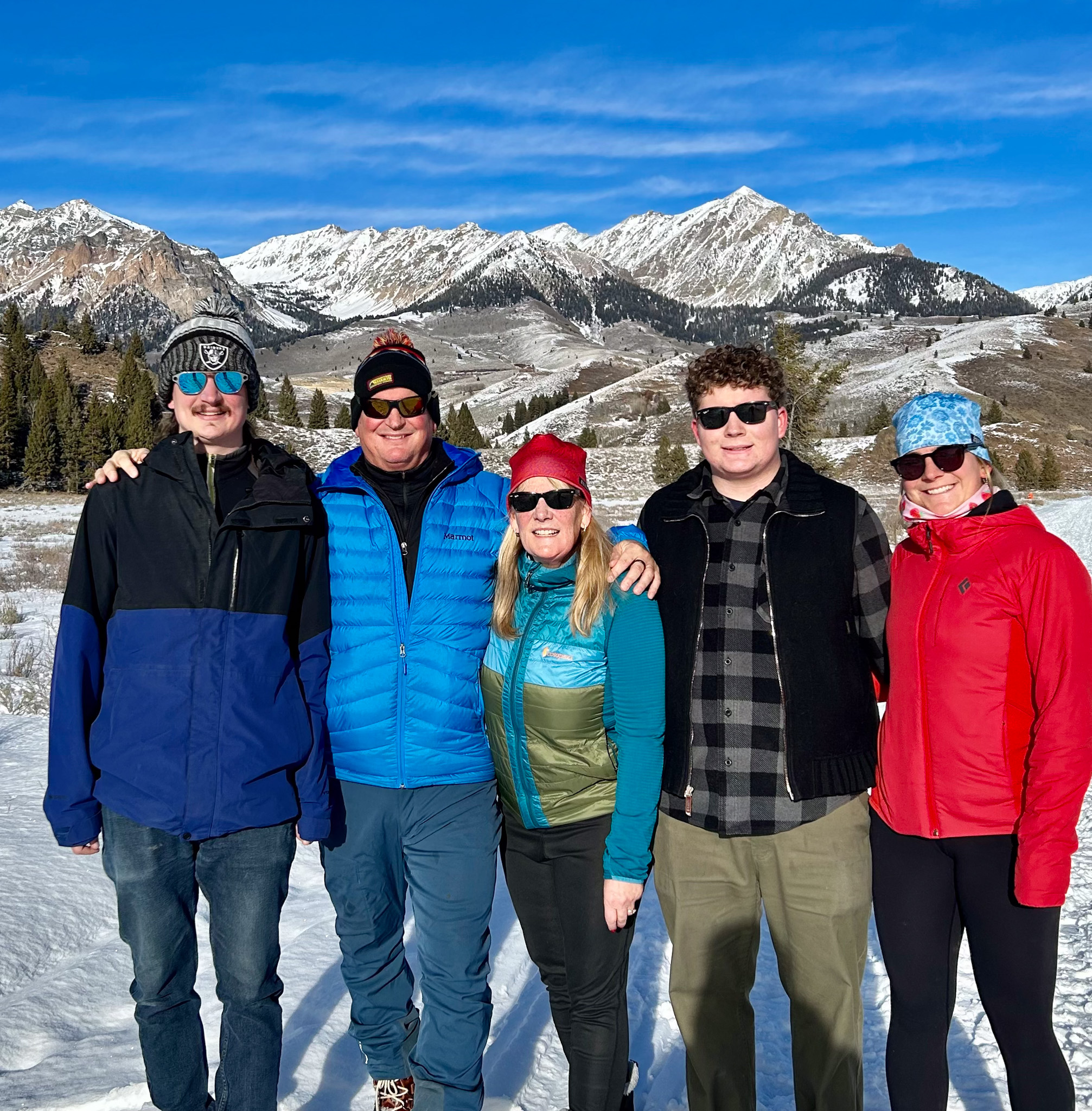
“We probably had the best visit we’ve ever had with Kyler. I mean it was just super special — skiing, going for snowshoes and had these long talks about his future and starting a family. Just an awesome family week. He actually left and texted on his way home that it was the best Christmas ever,” said Efinger.
He added that the episodes show how bipolar disorder works: riding an emotional high one week but near the bottom the next.
Treating with marijuana
Kyler chose to self-medicate and obtained a state-issued medical marijuana card. The cannabis seemed to keep him level, Efinger said.
“It did make him feel better. It wasn’t necessarily comfortable for our family. So even at Christmas, we had to send them outside to do what he was doing. But what I’ll say is he was level for… Well, he’s kept the same job as a night attendant at the Holiday Inn for three and a half years and so a fairly normal life.”
Kyler’s medical doctors told the family marijuana wasn’t a proven technology. Worse, it could intensify his bipolar disorder episodes and increase the potential for a manic state.
“That’s probably what we saw on New Year’s Day. It’s the worst manic episode he’s ever had,” Efinger said.
Final manic state triggered
When Kyler was approaching a manic state, he would stop sleeping, Efinger said.
“I really think he may have gone a week without sleeping,” Efinger said. “It just totally sets off this manic behavior. But again, you’re feeling so alive and well and energized in this state that you can’t sleep. So you just keep going. I think that totally led to his final episode.”
Kyler wore dreadlocks and texted his father that he thought he was being profiled.
“Maybe at this point he is showing some signs of manic… he does get taken aside [by TSA]… I don’t know all the details of that but his text to us where ‘I’m being profiled.’ I have no idea if that’s true or not,” Efinger said.
Kyler ended up missing his flight to Colorado Springs. Kyler said he didn’t want to wait for the next flight to Colorado Springs but instead, he wanted to fly to Denver and drive to his grandfather’s home.
But the next flight to Denver didn’t leave Salt Lake City for four hours, Efinger said.
“Those are his last four hours. I’m sure you’ve seen some of the video that’s been been posted online. I mean he is just highly manic in these videos.”
No one helped
Of all the visitors and workers at the airport that day, not one person stopped to ask if Kyler needed help.
“And that’s everything from the Christians that are walking by him, to staff. Right? I mean it’s amazing to me that for four hours he managed to avoid anyone helping him, including professionals.”
“We really hope that our efforts can maybe help the next family that’s going through that,” Efinger said.
Because airports can be stressful places, maybe the next phase in helping others experiencing similar difficulties is having a full-time mental-health specialist on staff at airports nationwide, Efinger said.
Focusing on mental illness in mountain towns
After his son’s death during a bipolar episode, Efinger said the family is registering a non-profit foundation for Kyler called Love Like Ky.
“We hope to go around — at least to start — to mountain towns because that’s what we’ve known: Park City and Sun Valley. It just seems like the mountain towns are — there’s an elevated state of mental health crisis. I think it is a national issue, but it just does seem to be even more prevalent in these mountain towns,” Efinger said.
‘They all want to be normal’
It took Efinger a while to figure out who Kyler was. He wanted his son back in school and working a job. But that didn’t work for Kyler.
“He saw that as not understanding. He saw it as being pressured into doing what I wanted him to do… Maybe two or three years into it, I just felt like I had to change — and so I did. I released all of that and just saw Kyler as my son.”
Efinger said he was there to help in any way he could, but Kyler “needed to drive the bus.”
Kids need to know they’re not alone. They all want to be normal and find the best-fitting community for them, Efinger said.
“I don’t think Kyler did enough of that. I wish he had done more.”
Self-medicating didn’t work for Kyler
From his experience, Efinger said self-medicating is not the solution for individuals affected by bipolar disorder.
“In our case, it supports some of the research that cannabis is not a solution for mental health and particularly in the adolescent brain. Some of the studies I’ve read — it’s not helpful at all. It actually increases the dysfunction, the brain dysfunction,” Efinger said.
He closed by saying that life is fragile when a family member suffers from a mental health disorder.
“You can just never let your guard down… it was the best Christmas ever, but it turned into the worst New Year’s ever.”
What to do if you are in crisis
If you are in crisis, please call 988 to connect with the 988 Suicide and Crisis Lifeline.
Huntsman Mental Health Institute Crisis Line: 801-587-3000
SafeUT Crisis Line: 833-372-3388
Trevor Project Hotline for LGBTQ teens: 1-866-488-7386
Online resources: NAMI Utah
Related:
- Coalition publishes document detailing needs, barriers in Utah behavioral health
- Studies show men experience high rates of loneliness
- Small screens impacting the mental health of kids, says study
Dave & Dujanovic can be heard weekdays from 9 a.m. to noon on KSL NewsRadio. Users can find the show on the KSL NewsRadio website and app, as well as Apple Podcasts and Google Play.