Preventing Deer Damage
May 21, 2016, 11:39 AM | Updated: Jul 19, 2022, 10:41 am
Quick Facts…
It is difficult to move deer out of areas where they are not wanted. A hungry deer will find almost any plant palatable, so no plant is “deer proof.” The two types of deer repellents are contact repellents and area repellents. Netting can reduce deer damage to small trees. Adequate fencing to exclude deer is the only sure way to control deer damage.
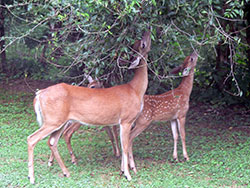
Although browsing deer are charming to watch, they can cause extensive damage by feeding on plants and rubbing antlers against trees. In urban areas, home landscapes may become the major source of food. Deer can pose a serious aesthetic and economic threat. Damage is most commonly noticed in spring on new, succulent growth. Because deer lack upper incisors, browsed twigs and stems show a rough, shredded surface. Damage caused by rabbits, on the other hand, has a neat, sharp 45-degree cut. Rodents leave narrow teeth marks when feeding on branches. Deer strip the bark and leave no teeth marks.
Management Strategies
It is difficult to move deer out of areas where they are not wanted. Not all strategies are practical for every homeowner. Frightening deer with gas exploders, strobe lights, pyrotechnics or tethered dogs typically provides only temporary relief. More practical management strategies include selecting plants unattractive to deer, treating plants with deer repellents, netting and tubing, and fencing.
Placement and Selection of Plants
The placement of plants in part determines the extent of damage. Plant more susceptible species near the home, in a fenced area, or inside a protective ring of less-preferred species. Table 1 lists plants and their susceptibility to deer damage. A hungry deer will find almost any plant palatable, so no plant is “deer proof.” Also, a plant species may be damaged rarely in one area but damaged severely in another.
Repellents
The two types of deer repellents are contact repellents and area repellents. Contact repellents are applied directly to plants, causing them to taste bad. Area repellents are placed in a problem area and repel by their foul odor. Repellents are generally more effective on less preferred plants.
Apply repellents on a dry day with temperatures above freezing. Treat young trees completely. Older trees may be treated only on their new growth. Treat to a height 6 feet above the maximum expected snow depth. Deer browse from the top down. Hang or apply repellents at the bud or new growth level of the plants you wish to protect.
A spray of 20 percent whole eggs and 80 percent water is one of the most effective repellents. To prevent the sprayer from clogging, remove the chalaza or white membrane attached to the yolk before mixing the eggs. The egg mixture is weather resistant but must be reapplied in about 30 days. See Table 2 for a list of commercially available repellents and their ratings against deer and elk browsing in Colorado.
Home-remedy repellents are questionable at best. These include small, fine-mesh bags of human hair (about two handfuls) and bar soap hung from branches of trees. Replace both soap and hair bags monthly. Deer have been reported to eat the soap bars. Materials that work in one area or for one person may not work at all in an area more highly frequented by deer.
Netting and Tubing
Tubes of Vexar netting around individual seedlings are an effective method to reduce deer damage to small trees. The material degrades in sunlight and breaks down in three to five years. These tubes can protect just the growing terminals or can completely enclose small trees. Attach tubes to a support stake to keep them upright. Another option is flexible, sunlight-degradable netting that expands to slip over seedlings. Both products are available from Colorado State Forest Service offices.
Paper or Reemay budcaps form a protective cylinder around the terminal leader and bud. They may help reduce browse damage. Budcaps are rectangular pieces of material folded lengthwise and stapled around the terminal leader.
Tubes placed around the trunks of larger trees will help prevent trunk damage. Tubes may not, however, protect trunks from damage when bucks use the trees to scrape the velvet off their antlers. Fencing may be required.
Fencing
Adequate fencing to exclude deer is the only sure way to control deer damage. The conventional deer-proof fence is 8 feet high and made of woven wire. Electric fences also can be used. Electric fences should be of triple-galvanized, high-tensile, 13.5-gauge wire carrying a current of 35 milliamps and 3,000 to 4,500 volts. Several configurations of electric fences are used: vertical five-, seven-, or nine-wire; slanted seven-wire; single strand; and others. When using a single strand electric fence it helps the deer to ‘notice’ that the wire is there if it is marked with cloth strips, reflective tape or something similar. Otherwise, the deer may not see it in time and go right through it.
Additional options include invisible mesh barriers, slanting deer fences, and single-wire, electric fences baited with peanut butter. The invisible mesh barriers are polypropylene fences of various mesh sizes, typically 8 feet high with a high tensile strength, that blend in with the surroundings. The baited fences attract deer to the fence instead of what’s inside the fence. They administer a safe correction that trains the deer to stay away. They are effective for small Gardens, nurseries and orchards (up to 3 to 4 acres) that are subject to moderate deer pressure. Deer are attracted by the peanut butter and encouraged to make nose-to-fence contact. Deer, like many wild animals, seem to respect and respond better to electric fencing after they become familiar with the fenced area. Additional information on fences and their construction can be found in Deer (Craven and Hygnstrom), available from Colorado State University Extension offices. (See references.)