Water-wise mindset for Utah landscapes
Apr 12, 2026, 9:56 AM | Updated: Apr 17, 2026, 2:57 pm

Utah water usage is impacted by the types of landscaping homeowners have. (localscapes.jvwcd.gov, courtesy)
(localscapes.jvwcd.gov, courtesy)
SALT LAKE CITY – With the population of Utah slated to double by 2065, the Utah Division of Water Resources (UDWR) encourages all of us to do our part to conserve water wherever possible.
“In the last three decades, Utah’s climate has experienced increasing dryness, more pronounced weather extremes and increased population growth. However, how we use our water hasn’t changed at the same pace. To ensure the well-being of current and future generations, it is crucial that we adapt our approach to water use.”
With so many options from water-smart appliances to landscaping, it can be hard to know where to start. The UDWR made a resource that gives homeowners, community leaders, and business owners many guides and options to do their part to “slow the flow”.
UDWR gives this advice on getting started with your water-wise plan: “Transforming your landscape to be waterwise can feel overwhelming. To make it easier, divide your landscape into smaller project areas. The easiest place to start is the park strip or side yard. To avoid burnout, focus on planning for and completing one project each year.” They also give a great chart of when to start certain projects throughout the season.


On the KSL Greenhouse Show, Maria Shilaos said, “[We know] it is not cheap to make these changes… we understand, and let’s be realistic, it’s hard to make these changes and it is expensive… But the good thing is that there is now some low-cost resources, there are incentives that can help you. Just make sure, if you are taking advantage of something like the “Flip the Strip” program, you don’t start working on it until you take a picture of it because they want to approve the project before giving you any sort of incentive.”
One of the easiest and cheapest ways to bring down your water consumption is to simply cover your garden bed and trees with mulch to prevent the water from evaporating before getting to your soil. Mulch is a layer of inorganic (like gravel or stone) or organic material (like woodchips or bark) that is spread around the base of planting beds, tree wells and pathways to reduce weed presence, increase soil moisture retention, and prevent soil compaction.
Taun Beddes says you can save up to “50% of the water you use by using 2-3 inches of mulch.”
Another tip UDWR gives to help you increase water efficiency and curb appeal is planning your own Localscape. Localscape is a program sponsored by Jordan Valley Water Conservancy District (JVWCD) where you learn how to effectively divide your yard into five functional, beautiful, and water-smart areas.
Localscape Categories
- Central Open Shape: The defining element of a Localscape, the central open shape can be lawn, hardscape, or groundcover.
- Gathering Areas: Hardscape spaces to gather with friends and loved ones — like patios, seating areas, fire pits and decks.
- Activity Zones: Areas outside of the lawn designed for your favorite activities, like horseshoe pits, trampolines and hot tubs.
- Paths: Connect the previous elements with pathways. Paths are never made from lawn but can be concrete, pavers, stone, or compacted mulch.
- Planting Beds: The remaining spaces become the planting beds — the finishing touch to your Localscape.
Visit localscapes.jvwcd.gov, where you can learn more, find classes on Localscapes, and get inspiration for your home. Great deals on mulch, path pavers, and more water-smart tools to help your water-wise journey can be found in your local garden centers and box stores as spring gets into full swing.
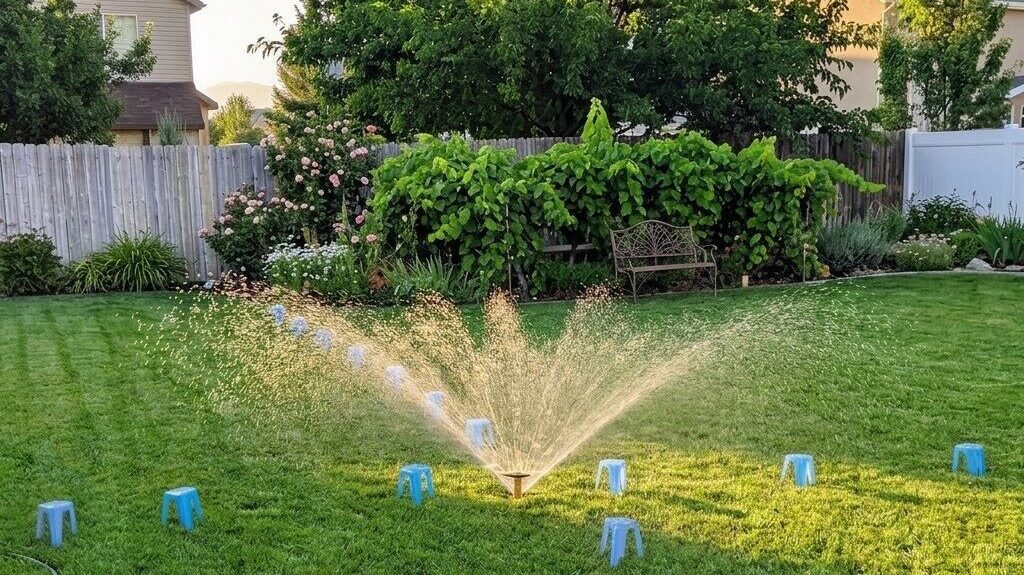
An obvious part of your water-wise plan is your watering strategy. You can earn rebates from the Slow the Flow program if you switch to a smart water controller or implement drip irrigation in your garden. Jordan Valley Water Conservancy District encourages waiting until May 18th to start routine lawn watering. If you are looking for watering guides tailored to your local county, you can look at the UDNR Weekly Lawn Watering Guide.
As a general rule, once peak watering season starts, you should water 2-3 times per week before sunrise, to make sure the water ends up in your soil and does not evaporate. It is also recommended that instead of running sprinklers all at once, split the total run time into three shorter cycles with 30–45-minute breaks in between. This ‘cycle and soak’ method helps the soil absorb water and reduces runoff.
Water is a key resource in Utah’s ecology, economy, and recreation zones, from our dwindling lakes and reservoirs to our snowcapped mountains. In our efforts to be water-wise in our daily lives, we can all make a positive impact. Remember, you can still have a water-wise house with lovely greenery and flowers.
Every week on The Greenhouse Show, we talk about great options for grasses and plants that are great in both water efficiency and curb appeal. You can have a beautiful landscape with vibrant plants, while still conserving water for future generations.
Read more: Conservation expert urges responsible water use