Why the bankruptcy stigma, when medical debt is No. 1 cause?

Oct 11, 2021, 5:56 PM

bankruptcy...

Photo: Adobe Stock

SALT LAKE CITY — A stigma surrounding bankruptcy persists, despite the fact that the top two reasons people go bankrupt in the first place are (1) medical expenses and (2) job loss  — scenarios debtors may not have control over.

A survey reported by CNBC found that two-thirds of all bankruptcies were tied to medical issues, either because of the high costs for care or time out of work.

A 2015 study by the Kaiser Family Foundation found that medical bills caused 1 million U.S. adults to declare bankruptcy every year and that 26% of Americans ages 18 to 64 struggled to pay medical bills, according to World Population Review.

However, there’s proof that Americans filed fewer bankruptcies in recent years, and that Americans were able to pay down debt during the COVID-19 pandemic.

So why does the stigma persist?

First, the good news

The pandemic shuttered shops and restaurants and closed workplaces as jobs dried up. Yet bankruptcies in America dropped during the lockdown —  496,565 consumer bankruptcy petitions were filed last year. That’s the lowest number since 1987. And it represents a 31% decline from 2019 according to MarketWatch.
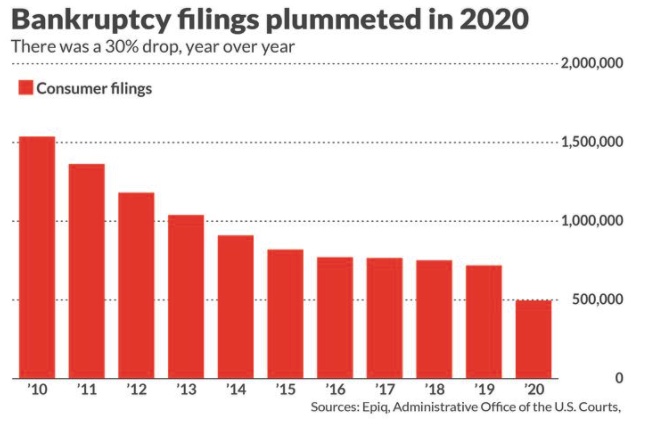
 

The total number of new US Chapter 7 and Chapter 11 bankruptcy cases filed for the 12 months ending June 30, 2021, was the lowest since 1985, according to the Administrative Office of the U.S. Courts. 

The federal government’s stimulus package helped stave off evictions for renters and put money in the pockets of the unemployed. It even allowed for many to pay down existing debt. As of May 26, 2021, Uncle Sam has sent out approximately $391 billion directly to taxpayers, bringing the total number of payments to almost 167 million, reported CNBC.

A financial blemish on your record

Why does it carry this stigma? Dave Noriega and Debbie Dujanovic asked Certified Financial Planner™ Shane Stewart with Deseret Mutual Benefit Administrators (DMBA).

“It’s assumed that, whether it’s true or not, it’s assumed that they’ve mismanaged their money,” Stewart said.

“That’s probably where the biggest stigma comes. The other part of the stigma comes from not only mismanagement but . . . it’s assumed that that person is just trying to leave their debtors high and dry.”

The different types of bankruptcy

Stewart explained the two types of bankruptcy that he deals with. The first, Chapter 7 bankruptcy, allows liquidation of assets to pay creditors.

Under Chapter 7, “your unsecured debt is discharged, but you do have to liquidate some assets. Now many people choose that, in fact, over 70% of bankruptcies are Chapter 7 because many times they don’t have assets to take,” Stewart said.

Chapter 13 is a reorganization of a debtor’s finances under the supervision and approval of the courts.

“It [Chapter 13] takes a little longer. You’re agreeing with creditors to — over time — take some time and pay maybe less on the payments until you can get your feet under you,” Stewart said, adding about 28% of US bankruptcies are filed under Chapter 13.

But before you file …

Before declaring bankruptcy, Stewart recommended seeking out a nonprofit credit-counseling service.

“There are a couple even locally in the Wasatch Front that are funded by grants,” Stewart said. “They help you try to reorganize your debts before having to declare bankruptcy. I would try it out first.”

Dave & Dujanovic can be heard weekdays from 9 a.m. to noon. on KSL NewsRadio. Users can find the show on the KSL NewsRadio website and app, a.s well as Apple Podcasts and Google Play.  

Related reading:


We want to hear from you.

Have a story idea or tip? Send it to the KSL NewsRadio team here.

Dave & Dujanovic

White Pine Lake in Little Cottonwood Canyon on Sept. 12, 2024. Photographer was solo hiking. (Maria...

Mariah Maynes

Hiking alone? Pack these essentials

Whether you'll be solo hiking or going with a group, these essentials can help you in the event of an emergency.

1 year ago

“Free college” might be overstating it a little bit, but in Utah, you could walk away with a co...

Dave Noriega

Noriega: Free college isn’t just for star athletes

In Utah, you could walk away with a college degree with little to no debt, and you don’t have to be a five-star athlete with a fat multi-million NIL deal.

1 year ago

The Animal Humane Society (AHS) estimates that 250,000 animals are victims of hoarding. They claim ...

Dave Noriega

Noriega: Animal hoarding is far more common than you realize

The Animal Humane Society (AHS) estimates that 250,000 animals are victims of hoarding. They claim that it’s the top animal cruelty crisis in America

1 year ago

BYU grad student Suguru Onda in a BYU research lab. Onda said his Form I-20, for I-20 visa, has bee...

Adam Small

BYU grad student has I-20 visa revoked, leaving student, family, unclear

Suguru Onda has been living legally in the US with a Form I-20, or I-20 visa, and said he has one year before completing his doctoral degree.

1 year ago

Sam Herrera

How to file your taxes for free in 2025

For DIY tax-filers hoping to save some money, there are several options available online to file taxes for free.

1 year ago

On Thursday the House of Representatives passed the SAVE Act, which would require proof of U.S. cit...

Michelle Lee

How would the SAVE Act affect Utahns if it becomes law?

How would the SAVE Act, which would require proof of U.S. citizenship when registering to vote, affect Utahns if it becomes law?

1 year ago

Sponsored Articles

...

Bear Lake

Road trip ready: How Bear Lake became the go-to destination for Western U.S. travelers

Whether you are chasing pristine beaches, fresh raspberry shakes, or endless water sports, this sponsored guide—brought to you in partnership with Bear Lake —uncovers everything you need to plan the ultimate getaway.   There’s nothing quite like the thrill of hopping in the car with your favorite snacks in tow and heading out for a […]

...

Harper Clinic

A new standard of care: How Harper Clinic’s IOP is changing the face of mental health treatment in Utah

This article is sponsored by Harper Clinic, a Utah-based clinic offering FDA-approved TMS therapy for treatment-resistant depression.    Utah’s mental health crisis is leaving many residents caught in an uncomfortable middle ground: struggling too much for weekly therapy alone, but unable to step away from work, parenting or daily life for inpatient treatment. As demand […]

...

Harper Clinic

Breaking free from depression: How Harper Clinic’s TMS Therapy can help

This article is sponsored by Harper Clinic, a Utah-based clinic offering FDA-approved TMS therapy for treatment-resistant depression.    The weight of depression is real. Many people spend years fighting it, adjusting medications, managing side effects and wondering if this is simply how life is going to feel.   According to the World Health Organization, depression affects […]

mental health...

Andrew Adams, KSL

Library discussions bring men’s mental health to the surface

Therapists say it’s common for men to repress things like trauma, grief, stress and anxiety. Now, a new weekly series of discussions aims to help men bring it all to the surface.

...

Bear Lake Convention & Visitors Bureau

Cozy up in Bear Lake: Discover the magic of a winter getaway

SALT LAKE CITY – The holiday season shines brightest when time slows down and loved ones gather. Gifts, decorations and festive music come and go, but shared experiences tend to last much longer. Research supports that idea. Dr. Theresa E. DiDonato told Psychology Today that vacations can strengthen relationships by creating meaningful time away from daily […]

...

Harper Clinic

Rewriting the path to healing: Inside Harper Clinic’s whole-person mental health model

OREM — A few decades ago, you’d have had a hard time finding a doctor to treat both your mind and body; And a century ago, you’d have been hard-pressed to find a doctor to treat your mind at all. Today, medical professionals are understanding more and more the undeniable connection between the body and […]

Why the bankruptcy stigma, when medical debt is No. 1 cause?