North Korean defectors, experts question zero virus claim
Apr 20, 2020, 5:24 AM
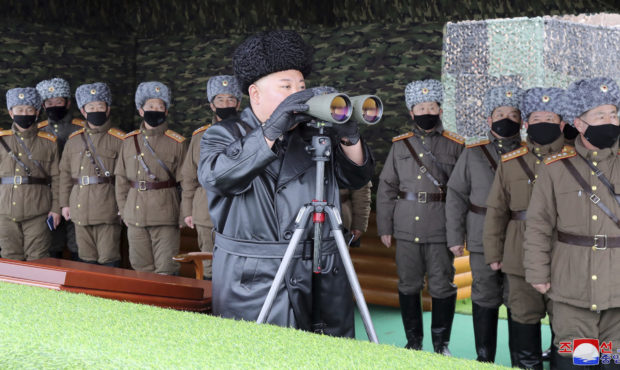
FILE - In this Feb. 28, 2020, file photo provided by the North Korean government, North Korean leader Kim Jong Un, center, inspects the military drill of units of the Korean People's Army, with soldiers shown wearing face masks. North Korea says it has zero coronavirus infections, but experts doubt it and say it’s likely the virus has already spread in the country. Independent journalists were not given access to cover the event depicted in this image distributed by the North Korean government. The content of this image is as provided and cannot be independently verified. Korean language watermark on image as provided by source reads: "KCNA" which is the abbreviation for Korean Central News Agency. (Korean Central News Agency/Korea News Service via AP, File)
(Korean Central News Agency/Korea News Service via AP, File)

SEOUL, South Korea (AP) — As a doctor in North Korea during the SARS outbreak and flu pandemic, Choi Jung Hun didn’t have much more than a thermometer to decide who should be quarantined.
Barely paid, with no test kits and working with antiquated equipment, if anything, he and his fellow doctors in the northeastern city of Chongjin were often unable to determine who had the disease, even after patients died, said Choi, who fled to South Korea in 2012.
Local health officials weren’t asked to confirm cases or submit them to the central government in Pyongyang, Choi said in an interview with The Associated Press.
Experts say North Korea’s reluctance to admit major outbreaks of disease, its wrecked medical infrastructure and its extreme sensitivity to any potential threat to Kim Jong Un’s authoritarian rule means that Pyongyang is likely handling the current coronavirus pandemic in the same manner.
This has led to widespread skepticism over the nation’s claim to have zero infections.
“It’s a lie,” Choi, 45, said. “Year after year, and in every season, diverse infectious diseases repeatedly occur but North Korea says there isn’t any outbreak.”
Outsiders strongly suspect that coronavirus, which has infected more than 2.4 million people, has already spread to North Korea because it shares a long, porous border with China, its most important trading partner and biggest aid benefactor. China is where the first known coronavirus cases were reported in December.
North Korea, which has quarantined tens of thousands and delayed the school year as precautionary steps, officially sealed its border with China in January, but smuggling across the frontier still likely happens. Activist groups in Seoul said they’ve been told by contacts in North Korea that people had died of the virus. Those claims cannot be independently verified.
While there have been no reliable outside reports of mass infections in North Korea yet, the country’s tight control on information allows few foreign experts to assert with an authority that the North’s quarantine regime has been successful. As seen in Singapore, the coronavirus can surge again, and North Korea’s powerful Politburo said last week it would further bolster anti-epidemic steps.
“I think a considerable number of people could die. But that won’t be disclosed to the outside world because the North is not even able to diagnose patients with (the coronavirus),” said Kim Sin-gon, a professor at Korea University College of Medicine in Seoul. He said North Korea is struggling to treat seriously ill patients, and noted U.N. reports that about 40% of its 24 million people are undernourished.
Russia’s foreign ministry said in February it donated 1,500 coronavirus test kits to North Korea, and observers say similar kits have also been shipped there from China. Some relief agencies, including UNICEF and Doctors Without Borders, said they sent gloves, masks, goggles and hand hygiene products to North Korea.
North Korea’s main newspaper recently called its public health system “the most superior in the world” and said that Kim Jong Un’s devotion to improving it is the reason why there are no infections.
North Korea’s socialist free medical service collapsed in the mid-1990s amid economic chaos and a famine that killed an estimated hundreds of thousands. In recent years, Kim Jong Un has built new hospitals and modernized some medical facilities as the economy improved, but most of the medical benefits still largely go to his ruling elite, experts say.
Dozens of refugees interviewed in a recent study said they felt the North’s health care system has become poorer under Kim Jong Un, according to Min Ha-ju, a North Korean refugee-turned-researcher. She said the gap between the haves and the havenots in terms of medical service is deepening because a crumbled state rationing system has led to a burgeoning private economy.
Choi, the doctor who worked in North Korea, said his monthly salary was the equivalent of about 2 kilograms (4.4 pounds) of rice and that he received cigarettes from patients in return for telling them what medicine they should buy at markets.
Cho Chung-hui, a former local North Korean official who is now with the Seoul-based NGO Good Farmers, said he gave cash to doctors to cure gastritis and enteritis.
Choi and Cho said measles, chickenpox, cholera, typhoid, paratyphoid, hepatitis and tuberculosis repeatedly swept through North Korea when they were there. Choi said he wore no masks, gloves or protective gear during outbreaks and used equipment manufactured in the 1960-70s.
During the 2002-2003 SARS outbreak, Choi said hundreds of people in Chongjin died after suffering flu-like symptoms during eight months of intense quarantine.
“But no (doctors) can dare to diagnose the dead with SARS. There wasn’t an order to confirm the cause of their deaths, and we didn’t have diagnostic kits,” said Choi, now a researcher at a Korea University-affiliated institute.
During a 2009 flu pandemic, Choi said he didn’t have diagnostic kits and asked patients with fevers what antibiotics they had used before placing some under quarantine. After many patients died, he speculated their deaths were likely linked to the flu.
In a highly unusual admission of a disease outbreak apparently aimed at winning outside aid, North Korea’s state media said in December 2009 that nine people in Pyongyang and the northwestern border town of Sinuiju had contracted the flu.
Some say North Korea may not have big clusters of infections because it doesn’t have densely populated cities and strictly restricts freedom of movement and association. But many others disagree, saying all North Koreans are required to attend diverse state-organized group activities and a lack of adequate sanitation could worsen outbreaks. There are also questions about the workings of North Korea’s quarantine campaign.
The North’s medical system is like a “a broken rusty pistol which doesn’t even have a bullet because it hasn’t been maintained for a long time,” Choi said.